Sunday, 29 April 2012

This Maria needs no fixin'

 The Citadel Theatre has presented a big musical pretty much every year since Bob Baker took over in 1999, and Edmonton audiences have loved him for it. Besides the theatre's annual Christmas hit, A Christmas Carol, the musical theatre productions are a box office lodestone for obvious reasons.
Musicals are goofy. People are suddenly impelled to break into song and dance just for the hell of it, but when the songs are so great that folks leave humming  them, and during the show a fresh ear worm riggles into consciousness every 10 or 15 minutes, why overthink the beauty of giving ticket buyers what they want? There's no shame in serving the art that sells. In fact, so popular are these musicals, normally the run gets extended even before it starts, which was true for The Sound of Music this year.
There are few musicals with as many memorable tunes as The Sound of Music, and Baker's current production of the 1959 Rodgers and Hammerstein chestnut has enough good singers in it to win over an already susceptible audience. Any successful musical has to start with a great selection of songs, but there is no substitute for solid singing to get the goofy thing across.
No woman singing the lead role of Maria can ever avoid being compared to Julie Andrews' in the 1965 film adaptation of the Broadway hit, but at the same time any singer cast in the role knows she's likely on her way up the mountain to a decent career because if you're Maria, it's your show, and if someone like Baker gives you that responsibility, it's bound to give you one more solid foothold on your way up.
Josée Boudreau
From the first appearance of Josée Boudreau striking the iconic pose Andrews made famous singing "the hills are alive with the sound of music," in the movie, arms outstretched in glorious optimism, relishing the sheer pleasure of singing, Bourdreau is convincing. She has a lovely voice that she can navigate from an unstrained Broadway belt into what I would call actual singing. It's always a relief when you know you aren't going to have to root for a singer to improve from a bad start.
Maria goes through a great range of experience in the Sound of Music. She has to deal with the convent characters, playing the defensive and the defiant postulant. She needs to enliven and manage the scenes when she and the von Trapp children are the focus, and she needs to seem plausible as a firm foil to the authoritarian stick in the mud Capt. von Trapp, and then his equal in her romantic relationship with the ultimately pliable captain. (The Lonely Goatherd scene is the singing nanny's biggest theatrical test, and Boudreau and the kids land it, both yodlewise and otherwise. Good, controlled rambunctiousness.)
Bourdeau vindicates Baker's belief in her. Baker has given Boudreau plenty of work and training over the past few years. He has seen her develop, and he has let her grow here in Edmonton. The New Brunswick-born, Toronto-trained makes Maria her own confidently and with genuinely fine musicality.
The rest of the cast, including a number of local actors/singers, is solid. The intermittent appearance of the nuns' chorus is always pleasant, not always perfect pitch-wise , but certainly pleasant. Susan Henley is obviously a versatile singing actor. Her My Favourite Things with Maria and her Climb Every Mountain scene with the nuns I'm sure tempted many audience members to sing along. I didn't hear anybody break into song.
Réjean Cournoyer has solid musical theatre chops. He, of course, will be compared to Christopher Plummer's take on Captain von Trapp. He doesn't do domineering as well as Plummer, and although Cournoyer is not a kid, the sense that he's en route to a sort of May-January engagement with young Maria doesn't quite come across. She's about to marry a man with seven-children, a man old enough to be her father, after all.
I especially liked Susan Gilmour as Elisa, the woman who is the captain's love interest, and more his age, until he starts hankering for the babysitter. Gilmour exudes her character's class, and she's obviously a real singer as well.
The children in the cast were fine. They're children, so let's just say, they're clearly capable of taking instruction and getting work done. Megan Anderson has a nice role as 16-going-on-17 Liesl, and Liesl gets a couple of scenes where she can be in charge. Anderson played her too demurely, I thought.
All the kids could hold a tune, but Ryan Jackson (Kurt) delivered a few beautiful boy soprano notes on his own at one point, and everyone in the audience recognized the effect excellent musical moments can have. Jackson will never play Maria, of course, but he has some serious musical potential.
Overall, Baker's Sound of Music delivers what any of the classic Broadway musicals that have made it into the standard repertoire can do. They give listeners the pleasure of sharing something both exceptional and familiar done live. The Citadel obviously believes in serving its community's tastes, and serve it it does with this tried and true musical.

Thursday, 12 April 2012

Nothing amateur about emerging actors

The Citadel Theatre's production of A Midsummer Night's Dream, opening tonight after a series of previews begun last Saturday when I saw it, presents a potential dilemma for the ticket-buying public.
The prices the Citadel is charging are its standard professional theatre ticket rates, but the majority of the performers are what are optimistically and encouragingly called "emerging artists."
The 14 young professionals — and it must be said that the depth of experience most of these in-training performers has is impressive — are performing here because the Citadel's artistic management has chosen them from dozens of theatre aspirants from across Canada and perhaps beyond to hone their acting craft. All of the young actors have worked professionally, some of them even in establishments like Stratford and the Canadian Stage Company in Toronto, and each of them has an impressive academy credential from a good Canadian theatre program, including the University of Alberta's and the National Theatre School's. There are lots of folks from Windsor's BFA in this group.
Director Tom Wood
Clearly these 20-somethings saw the Citadel's professional development program as a building block to help them construct a sustainable career as actors, and they've worked hard for a month to prepare for what is for many of them their Citadel Theatre debut in one of Shakespeare's most charming plays. A Midsummer Night's Dream calls for the kind of boundless energy young people can bring to a project. If ever a play required a cast of young talent, this fantastical romance is it.
So the question is, 'Will you get your money's worth from this professional production?', which is directed by consummate professional Tom Wood and designed by undeniably professional Bretta Gereke? Will you feel like you're coming to a student production that feels too much like a show pivoting on talent that is still some distance from prime-time ready?
Well the short answer is ABSOLUTELY NOT!
The opening scene in which a young man donning a stage beard and pretending to be a mature aristocrat creaked a little. But by and large, no actor made me feel like I had to compromise my normal audience expectations and simply endure, and most of them demonstrated convincingly that they deserve to be paid to entertain the ticket-buying public. The fairyland look Gereke has conjured and Wood's deft direction of the idyllic and frenetic aspects of the action are unequivocally top-quality Citadel production value.
Rose Napoli plays Hermia
Shannon Taylor
plays Helena

A few of the actors, such as Shannon Taylor as Helena and Rose Napoli as Helena's rival Hermia, were memorable. Taylor, a Toronto native, was excellent from start to finish. Napoli started a bit tentatively, but she was a hilarious terror by the farcical fight scene toward the end. The Mechanicals, especially Julian Arnold's blustrous Bottom, were consistently amusing bumblers. Arnold is an established local pro, and I don't want to read too much into it, but his performance had features that raised it a notch above the mark some of the greener folks made. One irony of the rustic players in this production, who are meant to seem totally out of their element on the stage, is that the developing actors who played them played bad actors terrifically.
The acrobatic Jonathan Purvis, completing his second stint in the Citadel program, literally took over the stage whenever he appeared, swinging from a rope, climbing walls and flipping through the air forwards and backwards when a mere stage leap might seem too pedestrian. He demonstrated what having total control of the actor's full instrument can look like in performance. He clearly revelled in his role as Puck.
Edmonton's Opera Nuova program develops emerging opera singers in a month to six-week boot camp like the Citadel/Banff intensive program for actors, and the opera camp culminates in two full-length opera productions at the end of the training period each year. Over the years that I've been going to those productions, I have noticed a sustained improvement in the performances of all the singers, most of whom don't have the breadth of stage experience the young actors bring to the Citadel. The singer who looks quite unsuited for the performance profession has been a rarity in the past few years.
My conclusion is that the selection process has become so assured that folks like Citadel artistic director Bob Baker are able to discover high-potential talent that is genuinely worthy of a critical audience's attention.
You don't have to believe in fairies to see the magic in this Midsummer Night's Dream.

Saturday, 7 April 2012

Pro Coro shares Easter season with friends

Pro Coro's Good Friday tradition continued April 6 at the Winspear Centre with an eclectic program of music fit for the saddest day of the Christian calendar. The choir, which was joined for several selections by the University of Alberta Madrigal Singers and was led by guest conductor Len Ratzlaff, who also leads the Madrigals and put the program together.
 About 1,000 people attended.
Leonard Ratzlaff
Even with the heftier forces of two chamber choirs, amounting to about 50 singers, it's always dicey placing such an ensemble too far back on the Winspear stage, even with the hall's excellent acoustics. For the opening piece, a sixteen-part setting of the motet Crucifixus by Antonio Caldara, an early Baroque composer, the singers were lined up single file along the shallow arc of stage's back wall.
 Ratzlaff must have had a technical reason for such a configuration since the full group's later collaborations were sung  more down stage and in  rows. The helpful accompaniment of organist Jeremy Spurgeon and Josephine van Lier on Baroque cello reinforced the slow, resonant unfolding of this meditative reminder that Christ "was crucified for us, under Pontius Pilate, suffered and was buried", but the effect of the still relatively small choral forces diffused as they were at the back was not as strong as an opening number should probably be. A piece with sixteen voice parts means small groups must emerge and recede with power and subtlety. I missed that in the Caldara.
The first four pieces were sung by the combined choir. Bruckner's Christus factus est pro nobis (the choir was forward and more clustered) highlighted the vocal of the singers in this a cappella motet. The Bruckner and contemporary composer Jeff Enns' Litany would be lovely things to hear at any Sunday morning church service.
Knut Nystedt's O Crux has recurring shades of dissonance common in much challenging contemporary choral music, enough seconds and minor seconds too convey notions of distress one expects from art depicting an execution site. The general point of the text doesn't dwell on the purpose of the Cross; its message is the paradox of the Christian teaching that somehow Christ's torture and execution is a good thing, and therefore so too must be the wooden scaffold on which he was killed. Many years the Pro Coro Good Friday event has featured classics like various Bach Passions, and one year, probably the most well-attended, Mozart's Requiem. It's always nice to hear less familiar music sung with musical quality and conviction.
Jolaine Kerley
Pro Coro sang Domenico Scarlatti's Stabat Mater by themselves, a piece made for Good Friday if there ever was one, a meditation on the helpless, grieving mother. Soprano Jolaine Kerley and tenor Caleb Nelson sang their short solo parts pristinely. The choir was in its element.
The second half began with an arrangement Amazing Grace. You can turn anything into a choral piece, I suppose, and choirs sing this hymn all the time. Erik Esenvalds' arrangement, sung by the Madrigals and Pro Coro, certainly gave the choir some lovely harmonies to sing, but I see Amazing Grace as a single singer's piece, and when Abra Whitney had her turn to express the penitent's remorse and gratitude, the song really sang the way I like it. She should have got an outright solo.
The final piece, supplemented by a number of Edmonton Symphony string players, was an inspired choice. Esenvalds Passion and Resurrection includes an extremely dramatic soprano solo role, and Kerley was brilliant doing it. The piece also calls for a vocal quartet, which Ratzlaff situated in the second balcony box to the right of the stage. This ensemble, too, was excellent. The text, like Handel's Messiah, is an assortment of biblical passages surveying the Christian story. This treatment of the story, has more to do with the Passion than the Resurrection, and Esenvalds uses the strings, choir and quartet in a great range of ways to capture all the anguish and hope in the religious tale. The strings controlled much of the dissonant effects, and Kerley carried the elevated emotions with great soloist flair.
This piece was a revelation, in itself, and it concluded a very intelligent program of music reflecting on the Holy Week drama.
Clearly Ratzlaff selected pieces that told different aspects of the Easter story: the Good Friday crucifixion, the meaning of the sacrifice, the sorrow that is ultimately ironic, the sorrowful song of the tearful believer who plays out the apparent mournful tragedy each Good Friday, a paean to the Christian's ultimate symbol,  the useful Cross and the grieving mother at its foot, and finally, the revelation that it was all a joke. You never expect a barrel of laughs from the Easter punchline, but excellent art is probably just as good.

Sunday, 1 April 2012

ESO introduces its new composer

The Edmonton Symphony program Saturday night drew a crowd that belied the notion that classical music is foundering on the rock of the aged. I've never seen so many people under 40 at an ESO concert. (Maybe I haven't gone to enough of them recently.) And what the full Winspear Centre, including about a quarter of the choir loft, heard was a little bit of new music untinged by notions that phrase "new music" often conjures, and a couple of chestnuts played engagingly under the direction of guest conductor Julian Kuerti, who was making his debut with the orchestra. His father, Anton, has played in Edmonton numerous times, and is a true friend of ESO. Julian will be invited back based on the leadership he gave the band his first time out.
After a seven-year hiatus since Allan Gilliland left, the ESO has a composer-in-residence again, and Robert Rival's first ESO commission, Achilles & Scamander, received its world premiere Saturday. Inspired by a scene in Homer's military epic The Illiad, Rival wrote an eight-minute programmatic work not surprisingly brimming with loads of brass and percussion. Rival has been praised for his taste for harmony that average listeners relate to, for his 'accessible' writing, and we got a work Saturday that inevitably explored aggressive ideas implicit in a war story, but his language isn't aggressive like some contemporary composers' medium. The audience seemed to like it.
The piece suggested John Williams' Star Wars music and Bernstein's Broadway sensibility in small ways, and I'm sure I heard a hint of music that sets up Wile E. Coyote getting flattened by a steamroller. What Rival doesn't do is stay on a allusiion so long that any of his possible influences sound derivative. Star Wars is an epic of its time, so why not borrow a little of contemporary musical epic flavour?
The scene Rival depicts involves Achilles as warmongering juggernaut, and Rival has a clear notion of how to convey juggernaut sonically. Full marks to timpanist Barry Nemish and the whole back row of brass players. In the several moments of lull in the martial frenzy, the bassoon, flute and harp gave moments of emotional relief nicely.
The ESO's past composers-in-residence have had an ear for music that doesn't attack the listener. Rival succeeds them in the spirit of music making that the Edmonton Symphony audiences have always appreciated. Make him work.
The feature artist, after Rival, of course, was cellist Shaun Rolston performing Dvořák's Cello Concerto. I was expecting Rolston to play her carbon fibre cello, but she came to blend and chose the wooden instrument like all the other string players played. Dvořák's concerto is not a battleground where orchestra and soloist compete for supremacy, and the ESO and Rolston demonstrated that collegial feature of the work powerfully and sensitively by turns.
The second movement in particular gives primacy to several wind and brass instruments (the short horn trio was pure and impeccable), and those exposed passages the ESO principals shone in their collaboration with Rolston. In fact, the whole night I heard no insecurity in places where soloistic matters could go awry.
The tempo of the second movement was exceptionally slow, but the choice worked to highlight Dvořák's unostentatious treatment of the concerto form.
The second half featured Tchaikovsky's Symphony No. 6. It's in large, dramatic symphonic works that the ESO's size affects its effect. In fact, without the harp behind the violas, there was a gaping empty space that gave an unbalanced appearance to the ensemble, visually if not sonically: density (in a small way) to the left, sparce forces to the right.
Kuerti conducts without ostentation. There are sections of turmoil, especially in the final movement of No. 6,, and the conductor engaged the players with physical intensity without drawing the eye to himself.
The orchestra is a little more than a month away from its trip to Carnegie Hall. It's sounding like this concert, like the rest of the month's programming, was a dry run for the moment of international exposure on the horizon. Things are sounding good.

Friday, 16 March 2012

God of Carnage devastatingly funny

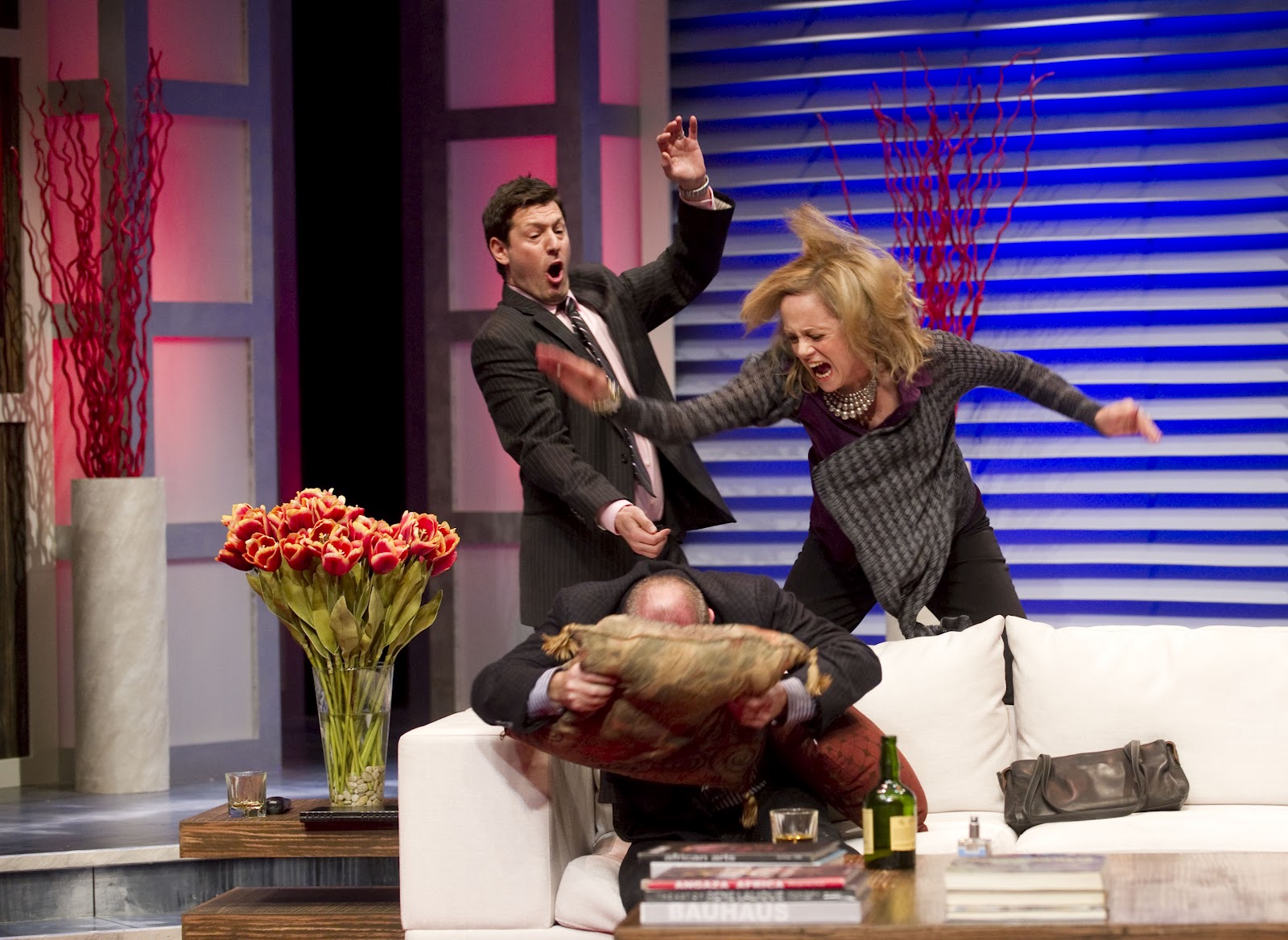
Veronica (Fiona Reid) gets ready to smack her husband Michael (Ric Reid) as Alan gets drawn into the fray in God of Carnage.
Yasmina Reza's God of Carnage, running at the Citadel Theatre until April 1, beyond being a giddy evisceration of our culture's ideals about love, marriage and family, is a relentlessly hilarious farce.
Reza's Tony-award-winning play, translated from French by Christopher Hampton, begins with Alan (Ari Cohen) and Annette (Irene Poole) sitting in Veronica (Fiona Reed) and Michael's (Ric Reid) living room discussing how to resolve a conflict their sons have had at school. Alan and Annette's boy has bashed a couple of teeth out of Michael and Veronica's son's mouth with a stick, and all the parents can agree that such violence is unacceptable and that the perpetrator, whom Alan is prepared to concede is "a savage," should be made to acknowledge his transgression and probably make some amends to his school mate.
As the couples debate the moral issues and the parenting philosophies that bear upon the incident they're trying to resolve, the civility of the opening discussion gradually descends into a series of insults, recriminations, and eventually even a little light violence, all the while revealing that seemingly decent people, regardless of their good intentions and social conditioning, can become, in one way or another, devotees of The God of Carnage.
As the meeting unfolds, Annette gets woozy and pukes her guts out all over her hosts' carpet and one of Veronica's prized possessions. Ric Reid's vigorous work with a dustbuster and a hairdryer cashes in on the comic currency of the vomit gag terrifically. Fiona Reid's obsessing over her vomit-saturated book seriously silly stuff.
The whole 90-minute play takes place on one set, but director James MacDonald has given the cast plenty room to milk Reza's dark wit and aggressive slapstick. Ric Reid and Poole's comic timing is totally pro, Fiona Reid's move toward derangement shows some accomplished comedic chops.
Fiona Reid is the idealist of the bunch, but once her threshold for patience and liberal tolerance is reached as Alan and Annette become less and less interested in conceding their son's faults, Reid becomes the God of Carnage's most passionate maenad, ready to dismember her husband as readily as her detestable adversaries in this demoralizing morality play.
Reza is utterly unsentimental about how couples can behave. Partners under stress can become incompatible strangers. (The divorce rate isn't as high as it is for nothing.) A common cause, like defending your own child against another tribe's impositions, has a tenuous hold when issues move from the domestic to the strictly personal. Throughout the play the characters find their allies on the other side of the conflict, which precipitates the slide toward chaos.
Reza's play has a dramatic arc that builds both the comic and the catastrophic dimensions of the action masterfully, and she's a mordantly funny writer, too. The climactic explosions of personal contempt (not to mention some propulsive gastro emissions thrown up) will shock some viewers, and Hampton's translation of the coarse language every character resorts to as debate deteriorates into derision and disgust is perfectly idiomatic. Great swearing can be at least as funny as an excellent display of hurling when done right.
The Citadel has mounted a wonderful play that should make you laugh till it hurts, and go away exhilarated and probably depressed by Reza's indictment of people's incapacity to mend fences that separate their common ground.
Bill Rankin

Monday, 20 February 2012

Citadel's Red a laugh a minute (not)

 John Logan's Tony-award-winning Red, playing at Edmonton's Citadel Theatre until March 4, mines American abstract painter Mark Rothko's austere aesthetics, which the wretched Russian emigre explained to art critic Harold Rosenberg. “I don’t express myself in my paintings; I express my not-self.” (Read the whole play before or after you see it — http://www.scribd.com/doc/49055081/John-Logan-Red) 

Most theatregoers won't be drawn to a play that feels more like a philosophy lecture than a human drama, and Logan has crafted a play that swirls about in the heady world of hard ideas, but is, at its core, the story of a despairing man who felt misunderstood, and whose ambition seemed to be to find even one person who could appreciate his artistic aim. Rothko was a grim idealist. Logan deliberately doesn't mention that Rothko had a second wife and a daughter in 1958, when he got the Four Seasons commission, the fulcrum for the play. Trivial matters like domestic relations couldn't have a place in Logan's project.

Logan shows us a Rothko who was conflicted in the desire to be properly recognized without being appropriated by the art buying public who saw art as over-the-mantel decoration and commercial investment. Rothko was known to greet fellow artists sarcastically with the question, "How's business?" (When Rothko killed himself 42 years ago this coming Saturday, he left behind 800 unsold paintings. In 2007, a Rothko sold for $73 million.)

A highlight of Logan's script is a fine Rothko diatribe on human superficiality of the sort that allows most of us to evade the demons that call some to oblivion before their time. Logan's Rothko is an Old Testament judge, indicting the masses for their despicable mediocrity and philistinism. He rails against inauthenticity. He ultimately condemns the very audience that comes to hear him speak in the theatre. Everything is absolutely not fine, thank you very much.

So why would you want to spend 90 minutes listening to a fuming alcoholic, devoid of empathy, self-absorbed and generally personally offensive?
Thank the writer and his conduit, actor Jim Mezon (Rothko) and newcomer David Coomber (Rothko's much put-upon gofer Ken). Logan's script rises above philosophical monologue because he reveals the humanity of the flawed Mark Rothko in the artist's element, a studio setting (David Boechler) where opera arias comfort the tortured painter and real art gets done. The scene in which Rothko and Ken frenetically lay a maroon primer onto a large canvas with house painting brushes reminds the audience that the ideas get their life from physical work. Rothko's ethereal vision of colour as a route to an ineffable metaphysics is the product of Johnny Walker Red and paint, real things that were never good enough for him, but helped make him who he was.
Logan kind of redeems Rothko in the end, but it's no happy ending.
Red is a terrific exploration in the world of ideas and art, but it is grounded in totally understandable human agony. The question of whether a child could paint a Rothko is beside the point. Rothko's originality is in his work, but the work is an imperfect reflection of the striving man, the foundation of good drama.

One audience member was determined to make her afternoon a pleasure. Certainly Logan's play has a dose of acerbic Rothko wit, but Red is no comedy. In fact, Rothko's relentless message is that all true humans must acknowledge the tragedy relived interminably. Red is no barrel of laughs, and that's just fine.

Saturday, 24 December 2011

Invisible music

Edmonton has a vibrant classical music community that operates almost invisibly thanks to the media's belief that only old folks and elitists are interested in reports on what's happening out there. My guess is maybe a half dozen concerts and operas get a review in a year. The local double A baseball club gets more coverage for games that draw a few hundred fans some days.
In the past several months, some of the world's most accomplished musicians, a few of them from right here, have filled local churches and concert halls. About 1,500 folks came out to hear Juliette Kang play the Brahms violin concerto at the Winspear Centre in late November. Twice as many heard a couple of excellent performances of the Messiah before Christmas. James Ehnes drew around 600 to a downtown church in October, and native son Jens Lindemann sizzled in front of two full houses at the Winspear this fall.
I like blues and and I love jazz, but unless B.B. King or Wynton Marsalis turn up at one of the larger venues in town, classical music attracts larger audiences to individual events than most jazz, blues or folk artists, and hardly anybody hears about it.
The premier newspaper in the city gives space to a year in review for blues, folk and jazz, and ignores the contribution that classical music makes to the cultural identity of Edmonton. The weird fact is that more people who read newspapers enjoy classical music than those who follow these other popular forms, including pop and rock, I'm guessing. The old folks and elitists are actual subscribers, not virtual ones.
At the risk of sounding like a whiny kid, IT'S NOT FAIR.