Friday, 16 March 2012

God of Carnage devastatingly funny

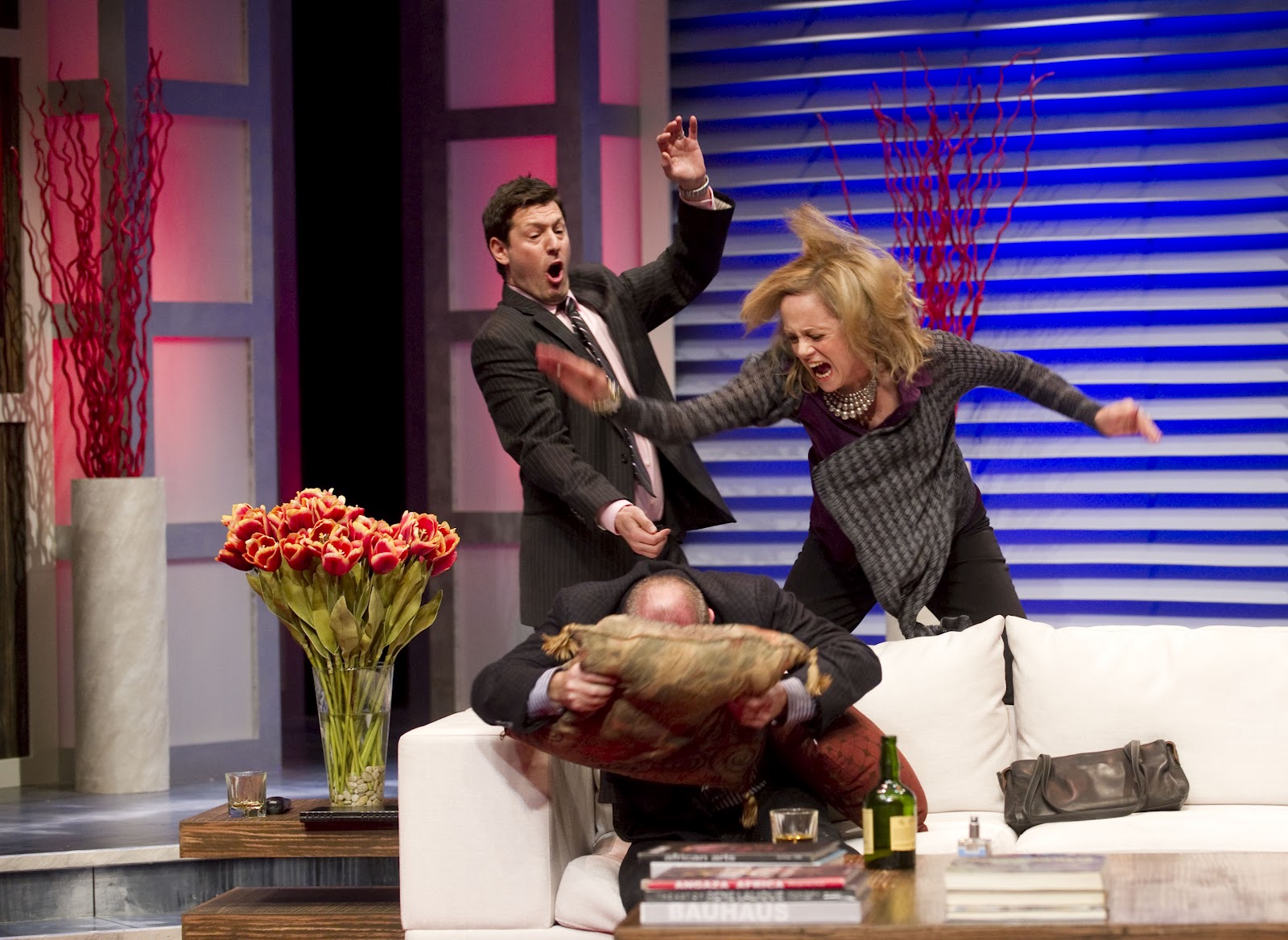
Veronica (Fiona Reid) gets ready to smack her husband Michael (Ric Reid) as Alan gets drawn into the fray in God of Carnage.
Yasmina Reza's God of Carnage, running at the Citadel Theatre until April 1, beyond being a giddy evisceration of our culture's ideals about love, marriage and family, is a relentlessly hilarious farce.
Reza's Tony-award-winning play, translated from French by Christopher Hampton, begins with Alan (Ari Cohen) and Annette (Irene Poole) sitting in Veronica (Fiona Reed) and Michael's (Ric Reid) living room discussing how to resolve a conflict their sons have had at school. Alan and Annette's boy has bashed a couple of teeth out of Michael and Veronica's son's mouth with a stick, and all the parents can agree that such violence is unacceptable and that the perpetrator, whom Alan is prepared to concede is "a savage," should be made to acknowledge his transgression and probably make some amends to his school mate.
As the couples debate the moral issues and the parenting philosophies that bear upon the incident they're trying to resolve, the civility of the opening discussion gradually descends into a series of insults, recriminations, and eventually even a little light violence, all the while revealing that seemingly decent people, regardless of their good intentions and social conditioning, can become, in one way or another, devotees of The God of Carnage.
As the meeting unfolds, Annette gets woozy and pukes her guts out all over her hosts' carpet and one of Veronica's prized possessions. Ric Reid's vigorous work with a dustbuster and a hairdryer cashes in on the comic currency of the vomit gag terrifically. Fiona Reid's obsessing over her vomit-saturated book seriously silly stuff.
The whole 90-minute play takes place on one set, but director James MacDonald has given the cast plenty room to milk Reza's dark wit and aggressive slapstick. Ric Reid and Poole's comic timing is totally pro, Fiona Reid's move toward derangement shows some accomplished comedic chops.
Fiona Reid is the idealist of the bunch, but once her threshold for patience and liberal tolerance is reached as Alan and Annette become less and less interested in conceding their son's faults, Reid becomes the God of Carnage's most passionate maenad, ready to dismember her husband as readily as her detestable adversaries in this demoralizing morality play.
Reza is utterly unsentimental about how couples can behave. Partners under stress can become incompatible strangers. (The divorce rate isn't as high as it is for nothing.) A common cause, like defending your own child against another tribe's impositions, has a tenuous hold when issues move from the domestic to the strictly personal. Throughout the play the characters find their allies on the other side of the conflict, which precipitates the slide toward chaos.
Reza's play has a dramatic arc that builds both the comic and the catastrophic dimensions of the action masterfully, and she's a mordantly funny writer, too. The climactic explosions of personal contempt (not to mention some propulsive gastro emissions thrown up) will shock some viewers, and Hampton's translation of the coarse language every character resorts to as debate deteriorates into derision and disgust is perfectly idiomatic. Great swearing can be at least as funny as an excellent display of hurling when done right.
The Citadel has mounted a wonderful play that should make you laugh till it hurts, and go away exhilarated and probably depressed by Reza's indictment of people's incapacity to mend fences that separate their common ground.
Bill Rankin

Monday, 20 February 2012

Citadel's Red a laugh a minute (not)

 John Logan's Tony-award-winning Red, playing at Edmonton's Citadel Theatre until March 4, mines American abstract painter Mark Rothko's austere aesthetics, which the wretched Russian emigre explained to art critic Harold Rosenberg. “I don’t express myself in my paintings; I express my not-self.” (Read the whole play before or after you see it — http://www.scribd.com/doc/49055081/John-Logan-Red

Most theatregoers won't be drawn to a play that feels more like a philosophy lecture than a human drama, and Logan has crafted a play that swirls about in the heady world of hard ideas, but is, at its core, the story of a despairing man who felt misunderstood, and whose ambition seemed to be to find even one person who could appreciate his artistic aim. Rothko was a grim idealist. Logan deliberately doesn't mention that Rothko had a second wife and a daughter in 1958, when he got the Four Seasons commission, the fulcrum for the play. Trivial matters like domestic relations couldn't have a place in Logan's project.

Logan shows us a Rothko who was conflicted in the desire to be properly recognized without being appropriated by the art buying public who saw art as over-the-mantel decoration and commercial investment. Rothko was known to greet fellow artists sarcastically with the question, "How's business?" (When Rothko killed himself 42 years ago this coming Saturday, he left behind 800 unsold paintings. In 2007, a Rothko sold for $73 million.)

A highlight of Logan's script is a fine Rothko diatribe on human superficiality of the sort that allows most of us to evade the demons that call some to oblivion before their time. Logan's Rothko is an Old Testament judge, indicting the masses for their despicable mediocrity and philistinism. He rails against inauthenticity. He ultimately condemns the very audience that comes to hear him speak in the theatre. Everything is absolutely not fine, thank you very much.

So why would you want to spend 90 minutes listening to a fuming alcoholic, devoid of empathy, self-absorbed and generally personally offensive?
Thank the writer and his conduit, actor Jim Mezon (Rothko) and newcomer David Coomber (Rothko's much put-upon gofer Ken). Logan's script rises above philosophical monologue because he reveals the humanity of the flawed Mark Rothko in the artist's element, a studio setting (David Boechler) where opera arias comfort the tortured painter and real art gets done. The scene in which Rothko and Ken frenetically lay a maroon primer onto a large canvas with house painting brushes reminds the audience that the ideas get their life from physical work. Rothko's ethereal vision of colour as a route to an ineffable metaphysics is the product of Johnny Walker Red and paint, real things that were never good enough for him, but helped make him who he was.
Logan kind of redeems Rothko in the end, but it's no happy ending.
Red is a terrific exploration in the world of ideas and art, but it is grounded in totally understandable human agony. The question of whether a child could paint a Rothko is beside the point. Rothko's originality is in his work, but the work is an imperfect reflection of the striving man, the foundation of good drama.

One audience member was determined to make her afternoon a pleasure. Certainly Logan's play has a dose of acerbic Rothko wit, but Red is no comedy. In fact, Rothko's relentless message is that all true humans must acknowledge the tragedy relived interminably. Red is no barrel of laughs, and that's just fine.

Saturday, 24 December 2011

Invisible music

Edmonton has a vibrant classical music community that operates almost invisibly thanks to the media's belief that only old folks and elitists are interested in reports on what's happening out there. My guess is maybe a half dozen concerts and operas get a review in a year. The local double A baseball club gets more coverage for games that draw a few hundred fans some days.
In the past several months, some of the world's most accomplished musicians, a few of them from right here, have filled local churches and concert halls. About 1,500 folks came out to hear Juliette Kang play the Brahms violin concerto at the Winspear Centre in late November. Twice as many heard a couple of excellent performances of the Messiah before Christmas. James Ehnes drew around 600 to a downtown church in October, and native son Jens Lindemann sizzled in front of two full houses at the Winspear this fall.
I like blues and and I love jazz, but unless B.B. King or Wynton Marsalis turn up at one of the larger venues in town, classical music attracts larger audiences to individual events than most jazz, blues or folk artists, and hardly anybody hears about it.
The premier newspaper in the city gives space to a year in review for blues, folk and jazz, and ignores the contribution that classical music makes to the cultural identity of Edmonton. The weird fact is that more people who read newspapers enjoy classical music than those who follow these other popular forms, including pop and rock, I'm guessing. The old folks and elitists are actual subscribers, not virtual ones.
At the risk of sounding like a whiny kid, IT'S NOT FAIR.

Sunday, 11 September 2011

Chris Hedges on what America's response to 9/11 wrought

"
I arrived in Times Square around 9:30 on the morning of Sept. 11, 2001. A large crowd was transfixed by the huge Jumbotron screens. Billows of smoke could be seen on the screens above us, pouring out of the two World Trade towers. Two planes, I was told by people in the crowd, had plowed into the towers. I walked quickly into the New York Times newsroom at 229 W. 43rd St., grabbed a handful of reporter’s notebooks, slipped my NYPD press card, which would let me through police roadblocks, around my neck, and started down the West Side Highway to the World Trade Center. The highway was closed to traffic. I walked through knots of emergency workers, police and firemen. Fire trucks, emergency vehicles, ambulances, police cars and rescue trucks idled on the asphalt.
The south tower went down around 10 a.m. with a guttural roar. Huge rolling gray clouds of noxious smoke, dust, gas, pulverized concrete, gypsum and the grit of human remains enveloped lower Manhattan. The sun was obscured. The north tower collapsed about 30 minutes later. The dust hung like a shroud over Manhattan. 
I headed toward the spot where the towers once stood, passing dazed, ashen and speechless groups of police officers and firefighters. I would pull out a notebook to ask questions and no sounds would come out of their mouths. They forlornly shook their heads and warded me away gently with their hands. By the time I arrived at Ground Zero it was a moonscape; whole floors of the towers had collapsed like an accordion. I pulled out pieces of paper from one floor, and a few feet below were papers from 30 floors away. Small bits of human bodies—a foot in a woman’s shoe, a bit of a leg, part of a torso—lay scattered amid the wreckage. 
Scores of people, perhaps more than 200, pushed through the smoke and heat to jump to their deaths from windows that had broken or they had smashed. Sometimes they did this alone, sometimes in pairs. But it seems they took turns, one body cascading downward followed by another. The last acts of individuality. They fell for about 10 seconds, many flailing or replicating the motion of swimmers, reaching 150 miles an hour. Their clothes and, in a few cases, their improvised parachutes made from drapes or tablecloths shredded. They smashed into the pavement with unnerving, sickening thuds. Thump. Thump. Thump. Those who witnessed it were particularly shaken by the sounds the bodies made on impact. 
The images of the “jumpers” proved too gruesome for the TV networks. Even before the towers collapsed, the falling men and women were censored from live broadcasts. Isolated pictures appeared the next day in papers, including The New York Times, and then were banished. The mass suicide, one of the most pivotal and important elements in the narrative of 9/11, was expunged. It remains expunged from public consciousness.
The “jumpers” did not fit into the myth the nation demanded. The fate of the “jumpers” said something so profound, so disturbing, about our own fate, smallness in the universe and fragility that it had to be banned. The “jumpers” illustrated that there are thresholds of suffering that elicit a willing embrace of death. The “jumpers” reminded us that there will come, to all of us, final moments when the only choice will be, at best, how we will choose to die, not how we are going to live.  And we can die before we physically expire.
The shock of 9/11, however, demanded images and stories of resilience, redemption, heroism, courage, self-sacrifice and generosity, not collective suicide in the face of overwhelming hopelessness and despair. 
Reporters in moments of crisis become clinicians. They collect data, facts, descriptions, basic information, and carry out interviews as swiftly as possible. We make these facts fit into familiar narratives. We do not create facts but we manipulate them. We make facts conform to our perceptions of ourselves as Americans and human beings. We work within the confines of national myth. We make journalism and history a refuge from memory. The pretense that mass murder and suicide can be transformed into a tribute to the victory of the human spirit was the lie we all told to the public that day and have been telling ever since. We make sense of the present only through the lens of the past, as the French philosopher Maurice Halbwachs pointed out, recognizing that “our conceptions of the past are affected by the mental images we employ to solve present problems, so that collective memory is essentially a reconstruction of the past in the light of the present. … Memory needs continuous feeding from collective sources and is sustained by social and moral props.” 
I returned that night to the newsroom hacking from the fumes released by the burning asbestos, jet fuel, lead, mercury, cellulose and construction debris. I sat at my computer, my thin paper mask still hanging from my neck, trying to write and catch my breath. All who had been at the site that day were noticeable in the newsroom because they were struggling for air. Most of us were convulsed by shock and grief. 
There would soon, however, be another reaction. Those of us who were close to the epicenters of the 9/11 attacks would primarily grieve and mourn. Those who had some distance would indulge in the growing nationalist cant and calls for blood that would soon triumph over reason and sanity. Nationalism was a disease I knew intimately as a war correspondent. It is anti-thought. It is primarily about self-exaltation. The flip side of nationalism is always racism, the dehumanization of the enemy and all who appear to question the cause. The plague of nationalism began almost immediately. My son, who was 11, asked me what the difference was between cars flying small American flags and cars flying large American flags.
“The people with the really big flags are the really big assholes,” I told him.
The dead in the World Trade Center, the Pentagon and a field in Pennsylvania were used to sanctify the state’s lust for war. To question the rush to war became to dishonor our martyrs. Those of us who knew that the attacks were rooted in the long night of humiliation and suffering inflicted by Israel on the Palestinians, the imposition of our military bases in the Middle East and in the brutal Arab dictatorships that we funded and supported became apostates. We became defenders of the indefensible. We were apologists, as Christopher Hitchens shouted at me on a stage in Berkeley, “for suicide bombers.” 
Because few cared to examine our activities in the Muslim world, the attacks became certified as incomprehensible by the state and its lap dogs, the press. Those who carried out the attacks were branded as rising out of a culture and religion that was at best primitive and probably evil. The Quran—although it forbids suicide as well as the murder of women and children—was painted as a manual for fanaticism and terror. The attackers embodied the titanic clash of civilizations, the cosmic battle under way between good and evil, the forces of light and darkness. Images of the planes crashing into the towers and heroic rescuers emerging from the rubble were played and replayed. We were deluged with painful stories of the survivors and victims. The deaths and falling towers became iconographic. The ceremonies of remembrance were skillfully hijacked by the purveyors of war and hatred. They became vehicles to justify doing to others what had been done to us. And as innocents died here, soon other innocents began to die in the Muslim world. A life for a life. Murder for murder. Death for death. Terror for terror.
What was played out in the weeks after the attacks was the old, familiar battle between force and human imagination, between the crude instruments of violence and the capacity for empathy and understanding. Human imagination lost. Coldblooded reason, which does not speak the language of the imagination, won. We began to speak and think in the empty, mindless nationalist clichés about terror that the state handed to us. We became what we abhorred. The deaths were used to justify pre-emptive war, invasion, Shock and Awe, prolonged occupation, targeted assassinations, torture, offshore penal colonies, gunning down families at checkpoints, massive aerial bombardments, drone attacks, missile strikes and the killing of dozens and soon hundreds and then thousands and later tens of thousands and finally hundreds of thousands of innocent people. We produced piles of corpses in Afghanistan, Iraq and Pakistan, and extended the reach of our killing machine to Yemen and Somalia. And by beatifying our dead, by cementing into the national psyche fear and the imperative of permanent war, and by stoking our collective humiliation, the state carried out crimes, atrocities and killings that dwarfed anything carried out against us on 9/11. The best that force can do is impose order. It can never elicit harmony. And force was justified, and is still justified, by the first dead. Ten years later these dead haunt us like Banquo’s ghost. 
“It is the first death which infects everyone with the feelings of being threatened,” wrote Elias Canetti. “It is impossible to overrate the part played by the first dead man in the kindling of wars. Rulers who want to unleash war know very well that they must procure or invent a first victim. It needs not be anyone of particular importance, and can even be someone quite unknown. Nothing matters except his death; and it must be believed that the enemy is responsible for this. Every possible cause of his death is suppressed except one: his membership of the group to which one belongs oneself.”
We were unable to accept the reality of this anonymous slaughter. We were unable because it exposed the awful truth that we live in a morally neutral universe where human life, including our life, can be snuffed out in senseless and random violence. It showed us that there is no protection, not from God, fate, luck, omens or the state.
We have still not woken up to whom we have become, to the fatal erosion of domestic and international law and the senseless waste of lives, resources and trillions of dollars to wage wars that ultimately we can never win. We do not see that our own faces have become as contorted as the faces of the demented hijackers who seized the three commercial jetliners a decade ago. We do not grasp that Osama bin Laden’s twisted vision of a world of indiscriminate violence and terror has triumphed. The attacks turned us into monsters, grotesque ghouls, sadists and killers who drop bombs on village children and waterboard those we kidnap, strip of their rights and hold for years without due process. We acted before we were able to think. And it is the satanic lust of violence that has us locked in its grip. 
As Wordsworth wrote:
Action is transitory—a step, a blow,
The motion of a muscle—this way or that—
’Tis done; and in the after-vacancy
We wonder at ourselves like men betrayed:
Suffering is permanent, obscure and dark,
And has the nature of infinity.
 
We could have gone another route. We could have built on the profound sympathy and empathy that swept through the world following the attacks. The revulsion over the crimes that took place 10 years ago, including in the Muslim world, where I was working in the weeks and months after 9/11, was nearly universal. The attacks, if we had turned them over to intelligence agencies and diplomats, might have opened possibilities not of war and death but ultimately reconciliation and communication, of redressing the wrongs that we commit in the Middle East and that are committed by Israel with our blessing. It was a moment we squandered. Our brutality and triumphalism, the byproducts of nationalism and our infantile pride, revived the jihadist movement. We became the radical Islamist movement’s most effective recruiting tool. We descended to its barbarity. We became terrorists too. The sad legacy of 9/11 is that the assholes, on each side, won.

This is the original web address. Try it. Let me know if it's alive.
http://www.truthdig.com/report/item/nationalism_in_the_aftermath_of_9_11_20110910/
Sunday, 21 August 2011

Lillian again

The remounting of John Estacio and John Murrell's Lillian Alling at the Banff Centre last week is most remarkable not because it's a solid piece of musical art that deserved a new audience but because it shows once again just how vibrant Alberta is as a place where new opera is nurtured. The performance I saw on Saturday night at the Eric Harvie Theatre was done by the Banff Centre's Opera as Theatre participants, a group of well-trained singers whose work was as entertaining as the original professional production I saw in Vancouver last fall. Several of the singers are clearly ready for prime time.
Kelly Robinson wasn't doing anyone any favours in selecting Lillian Alling as one of the two operas for this summer's program, along with Mozart's Cosi fan tutte. Mozart and Estacio. That's got a nice ring to it, doesn't it? The issue isn't whether Estacio's name will be around as long as Mozart's. The issue is that Banff and Robinson, head of Banff's theatre program and director of the Vancouver production, aren't afraid to promote Canadian work that is substantial and unique. He gave his aspiring opera singers a worthy test. The ensemble delivered a result that clearly pleased the nearly 800 listeners in the theatre on Saturday. What other test is there?
Isn't that the main reason some companies avoid new Canadian work? What will the audience think? Will we lose our shirts? Valid concerns, for sure, but Estacio and Murrell have proven that Canadian audiences will come to hear them.The Vancouver run was a critical and popular success, and so has been the Banff production. Filumena, their first collaboration, started in Calgary and made it to Edmonton and Ottawa. The CBC even showed a film of it.
The intricate narrative Murrell has constructed in Lillian Alling, and the rich orchestral score, played brilliantly by the Banff student orchestra, that Estacio has written, stand up as opera worth producing on any stage, anywhere. I know serious music critics who can't stand Nixon in China. It garnered enough interest though to make it into the standard repertoire, not because it's great.
The title character of Lillian Alling moves westward on her quest for justice. The opera Lillian Alling is moving eastward. It has made it over the mountains now. Its goal should be to make it at least as far as Toronto, where the COC is venturing into contemporary Finnish opera, set in the Middle Ages next season. Contemporary opera is not the COC's usual domain. Risky business, even for an opera that has mustered promoters sufficient to give the Finnish composer's Life from Afar life after its premiere.
My guess is Toronto opera lovers could find some of the same tolerance the city's hockey fans have for their haplessly predictable Leafs to come to hear a made-in-Canada opera that was good enough for Vancouver.
Some operas don't make history. Most of Mozarts 22 haven't. Terrific that Kaija Saariaho’s has beaten the odds. But it would be doubly terrific if audiences in Canada's largest city had a chance to see something built right here at home. Lillian Alling is worth the gamble.

Sunday, 17 July 2011

Placido Domingo and Rigoletto

I just finished watching the BBC production of Rigoletto http://www.guardian.co.uk/music/2010/jul/25/verdi-rigoletto-opera-bbc-television, starring Placido Domingo in the title role. It's a sexy and moving production set in the actual historic locations the Duke of Mantua lived and indulged in. The larger point about this production is one John Doyle has repeatedly made in the Globe since the CBC decided Wheel of Fortune and Jeopardy are the sorts of programs the public broadcaster should be investing in, not the arts like this British public broadcaster's unique opera commission.
The people with the power to dictate what we see on Canadian public broadcasting should be leaders, not followers. The kind of producers who are willing to use taxpayer's money to present the kind of quality programming represented by this Rigoletto are clearly not afraid of what the majority who prefer soccer or game shows think about seeing real art on TV, and that clearly isn't the kind of leadership behind CBC's programming decisions. I'm not one of the Canadians Harper refers to when he talks about Canadians, and there are thousands of us who are denied quality shows like this Rigoletto because they are timid followers, not leaders. Fortunately, we still get PBS from the U.S., where this BBC production was offered.

Wednesday, 6 July 2011

Malcolm Forsyth

A quote in the Edmonton Journal obit today of Malcolm Forsyth from Malcolm's friend Rayfield Rideout that included the sentence, "He would listen." underscores what I will remember about the several conversations I had with Malcolm. I always felt he was genuinely present whenever I had the pleasure to meet him or to interview him. He was almost always in teaching mode, which meant it paid to be a good listener too.
His intellectual curiosity is also something I admired. One time I phoned him for an interview and during the start of our chat he told me he had just been reading Descartes' theory of the pineal gland being the seat of the human soul. What a cool way to spend your free time, I thought, knowing how much of mine I waste. I'm happy I knew Malcolm just a little, and know there are many others who knew him far longer and far better than I who will miss him for a multitude of reasons. I have a few reasons too.