Sunday, 29 September 2013

Fine cast buoys grim O'Neill classic

Bill Rankin

The Citadel Theatre gives its audience several surefire crowd pleasers each season. It has done Beauty and the Beast a couple of times in the past half dozen years, and the Sound of Music and the wacky Spamalot, among others. But Bob Baker also programs theatre that can depress, even when it's served as a musical. Ride the Cyclone is a songfest about teens sent to their graves before their time, and Next to Normal manages to entertain while probing the toxic effects of living with a mental patient.

The opening work of the company's 48th season, Eugene O'Neill's grim autobiographical drama about the Tyrone family, is in a category of its own as a work of art that challenges an audience's tolerance for unhappy people in unhappy situations.

The wonder, though, is that Long Day's Journey Into Night, all three-and-a-half hours of it, a  a play where four characters burdened by addiction, mortal sickness, guilt and chronic self-delusion natter at and viciously judge one another, can still be compelling entertainment.
Much of the success of this production can be credited to the way Tom Wood portrays the villain of the piece: James Tyrone. The vain, alcoholic patriarch of the Tyrone clan is the engine that drives the family dysfunction O'Neill so relentlessly explores, and Wood plays the role with symphonic depth, charting the domestic drama through its descent into hopelessness and in the case of James's wife, Mary, oblivion. Without a strong James Tyrone, the play won't work, and ironically, Wood, playing a man who has little to give, gives this production the security it needs to hold course till the end.

The whole cast is strong. John Ulyatt as James Jr. appears restless and impatient in the early going, non-descript really, like a dormant volcano, perhaps, but by the end when he rants in an alcoholic fury against his father's weaknesses and failures, the stage is Ulyatt's, and he spews forth magnificently. The words of recrimination are O'Neill's, of course, but Ullyatt delivers the acid bath for his father's dunking with demonic zeal.

Brenda Bazinet plays the woman of the house, a morphine addict whose recurring lament is that because of her husband's itinerant life as an actor, she lived like a homeless person. Her drug habit, caused by her husband's neglect, made her a dependent in every way, incapable of nurturing her two boys or resisting her husband's self-aggrandisement to protect them or herself. Bazinet takes Mary to the abyss of psychological dissolution rather conservatively. O'Neill offers cues in his words to just how distant she becomes from the fractured lives of her family, and Bazinet uses the words to shape a character who is the most extremely dysfunctional family member but who disrupts the way carbon monoxide might, a kind of smothering threat that unbalances everybody else's effort to relate. She drifts away, but she does so almost methodically, as deliberately as she withdraws periodically to get another fix.

David Patrick Fleming is the consumptive son Edmund, who has left the family before the play begins to discovery the larger world but has returned as aimless as he ever was. His destiny, we understand, is death, both literally and figuratively. Edmund is obsessed with the transgressive philosophies of Baudelaire and Nietzsche, and is unquestionably an introvert, but except for the delightful (but depressing) scene with his father playing cards in Act 3. Fleming feels more peripheral than he might have been. He's the only good thing about the family, in a way, but underneath he's a maverick and at least theoretically, a radical, and I didn't see much of that potential in his brooding-poet persona. Nonetheless, for a young actor, he holds his own with a much more experienced cast.

In Long Day's Journey Into Night, O'Neill proves Tolstoy's point about the two types of families, perhaps. "Happy families are all alike; every unhappy family is unhappy in its own way." An audience isn't expected to identify with the very particular kind of pain O'Neill depicts, but he knows the scene of a train wreck is hard to resist. Dysfunction comes in degrees, and O'Neill's depiction of it helps define the dark end of the spectrum for good.

Set and lighting designers Leslie Frankish deserves applause for the rough-hewn space and atmosphere she creates the players' miserable journey, and Stancil Campbell's lighting makes the evening go by like a long, full day.
If you go, you'll get a 15 minute break, which you will be grateful for.

Sunday, 5 May 2013

ESO presents broad palette of French musical colours

 Bill Rankin

The Edmonton Symphony was in its element Saturday night in a program that the group's Francophile conductor Bill Eddins was clearly happy to direct.
The arc of the evening moved from deeply pleasurable, lyrical music, orchestral luxuriance focusing on conventional notions of musical beauty.
Ravel figured prominently in this concert, and the Ravel we got first is a friendly Ravel, full of musical ideas dedicated to melody and harmonic sweetness. The orchestra delivered all the Mother Goose Suite's charms; each tableau made its own lovely impression, but the final one, Le jardin féerique, was indeed enchanting.
Some of the music later in the program invites the concert hall standing ovation; this group of tableaux, when played as sensitively as the ESO played it Saturday, likely left listeners in spellbound reverie.
The suite was followed by Jean Françaix's Piano Concertino. Françaix has written music more challenging than the Concertino, but programming it after the enchanting Mother Goose Suite woke the audience from any dream it might have been in; the new mood was mood was still positive but more
playful.
The night's soloist was Christopher O'Riley, one of the world's most eclectic keyboardist. (Check out his collaboration with cellist Matt Haimovitz Shuffle, Play, Listen, which covers a spectrum of musical sensibilities that shows how classically trained musicians can play just about any kind of music and some, like O'Riley, do convincingly.) 
The Françaix has a spirit that really suggests generous musical concord between soloist and orchestra, and the musical partners made friendly music delightfully.
           Photo by Wendy Lynch
Christopher O'Riley
And then came a harsher Ravel, a Ravel that shakes and agitates and harumphs. O'Riley, a longtime friend of Eddins's, introduced the background of Ravel's Piano Concerto for Left Hand, explaining that Ravel wrote the unusual concerto for philosopher Ludwig Wittgenstein's brother Paul, who had lost his right arm in the First World War. It's hard not to look for war commentary in a piece with such provenance.
The opening movement begins darkly but not ominously, with the basses exploring their lower range in a tentative, neutral mood. Whatever allusions to the insanity of war may be in this concerto are on the horizon and not yet evoked.
The work is seamless; it doesn't have the typical three-movement divisions, giving the soloist and the orchestra an certain advantage in shaping the emotional frame of the music as a single developed statement.
The one-handed pianist may have an obvious physical impediment, but O'Riley made clear that feelings of defiance and even militaristic gestures in the late part of the piece aren't out of reach. Ravel gave the disadvantaged pianist opportunity to take out frustrations with emphatically pounding force, and he kindly left the pianist alone for most of his one-handed musical leadership, which O'Riley displayed exuberantly. The orchestra, for its part, delivered that edge and martial momentum that give the piece its symphonic stature.
O'Riley established his reputation as more than just another hot-shot concert hall soloist in the early eighties. I heard him play and hour and a half of his Radiohead piano arrangements in Royce Hall at UCLA in 2004, I think it was. He played it like a man on a mission. As an encore on Saturday, O'Riley played Radiohead's "You", giving the audience a taste of one other place he is musically.
It was O'Riley's first performance with ESO, and it was a great success.
In the second half, the orchestra played Sibelius's second symphony. The last time they played it, the guest conductor was the ESO's first music director, Brian Priestman. He could barely stand at the time, and directed it from a stool. Eddins had no such constraint.
This symphony has a through-composed aspect to it, revisiting repeatedly a theme introduced in the ebb-and-flow opening movement that begins with a kind of groping energy looking for a firmer musical footing.The symphony does finally find that footing and rises to a triumphal finale that Eddins and company delivered triumphally.
The audience clearly appreciated the big symphonic gesture that completed a very intelligently designed program that began in the world of idyllic dreaming and ended with an orchestral chestnut that screams confidence and strength.

Thursday, 11 April 2013

Splendid Penelopiad revisits epic domestic tragedy

                                                                                    Epic Photography
The full cast of Penelopiad at the Citadel Theatre
The central character of Margaret Atwood's theatrical adaptation of her novella Penelopiad is the paradigm of the patient, virtuous wife. She is the woman who withstands every inconvenience and even every humiliation that her husband submits her to and still remains faithful and, in the traditional telling, uncomplaining. Penelope, wife of überadventurer Odysseus, hero of Homer's epic poem The Odyssey, is a secondary character in the ancient tale, but in Atwood's re-imagining of the Odysseus story, the wife gets top billing, and she has a few things to complain about.
Her adventures, while she waited steadfastly for twenty years to see her wayfaring spouse return from the trouncing of Troy and ten years of nautical meanderings and a very bachelor-spirited drift back to Ithaca, are dramatic in their own way. But in the end, the drama she recounts in the play from her place in Hades, dead and gone but still remembering the hope and despair of her time on earth as the famous Wanderer's loyal consort, is the drama that Odysseus caused. Penelope may get her voice heard in  Penelopiad, but the story she tells and the eternal suffering she endures continue to be remnants of the aftershocks of her husband's self-centred, violent life on earth.
Nevertheless, Atwood's reflections on Penelope's place in the heroic, and ultimately anticlimactic ending of the Odysseus saga, are compelling, and compellingly rendered in this MacLab staging.
The Citadel production, running until April 21, features the 13 women in this season's Citadel/Banff Professional Theatre Program. Beth Graham is the ever-present narrator of this version of the Odysseus story; she plays the storyteller role engagingly, at times roused to anger by recollections of her unlucky life, at times movingly pathetic in revisiting her helplessness, her helplessness especially to save the 12 maids who spied for her against the brutish suitors who vied for Penelope's hand as she waited for her husband to come home. When Odysseus finally returned, he hanged the women, ostensibly because the despicable suitors had used them as concubines, and they were no longer fit to serve his household.
The spirits of the dead women haunt Penelope in the afterlife. The scene in Act Two when the women sing of their betrayal is beautifully staged and dramatically poignant.
Except for Gorham's starring role, this is an ensemble production; however, a few women do get some solo attention, and they deliver strong performances.
Mary Hulbert milks the role of the vain, self-possessed Helen for all it's worth, antagonizing Penelope in the early part of the play when the two are still alive and sexual rivals, and she continues to gall Penelope, playing the beauty card in the Underworld at already miserable Penelope's expense to some good comic effect.
Lisa Norton keeps the treble to a minimum in her depiction of the charismatic trickster Odysseus, portraying the clever man as masculinely as a woman could without resorting to caricature, and Claire Hesselgrave's Telemachus, the scion to the Odysseus legacy, does fine work in capturing the youth's false bravado and impotence against the grisly suitors who bully him mercilessly. Nadien Chu reminded me a little of Maureen Stapleton's inimitable Edith Bunker, not so squawky, but earthy and often very funny. She has some of the toughest Atwood language in the play.
Dressed in a form-fitting, stylish, white winding-sheet, Graham is the pivot of this Atwood take on the story, the quarterback of her own memoir and the victim of historic spousal neglect. Graham is on stage from start to finish, recounting and witnessing and participating in the story of her life. (This play resembles in a way The Kite Runner in its narrator-based structure.)
In the beginning, Graham recounts her early life with Odysseus, who wins her in race he cheated in, their short time as lovers (long enough to produce one son, Telemachus) and his departure to Troy, to, of all things, try to help Menelaus, Helen of Troy's cuckolded husband, fetch his wife back from her abductor, the Trojan Paris.
The legend has it that although Helen had been defiled by Paris (an old-fashioned notion now, perhaps), Menelaus was helpless against her renowned beauty and let her live after retrieving her with his Greek cohorts' military assistance.) Odysseus wasn't so kind to the household maids for their dubious service to their besieged mistress.
Penelopiad is simply but beautifully staged. I especially liked the way the sung chorus parts are integrated into the witty and forceful Atwood script, and all the women, thankfully, have triple-threat abilities as actors, singers and dancers.
This culmination of another year of intensive performance training in the Citadel/Banff program is wonderful theatre, full of wonderful writing and strong stage talent.

Saturday, 30 March 2013

Pro Coro's Good Friday tradition continues

 Bill Rankin

Pro Coro's Good Friday concert tradition on, uh, Friday, attracted about a thousand listeners to Edmonton's Winspear Centre. The Good Friday event has always been an excellent draw for Pro Coro, especially when there's a well-known choral work on the program, and this year it was one of the top five pieces in the canon: Mozart's Requiem.
But before the audience heard the Requiem in the second half, Pro Coro did what it has always done best; it sang a couple of acapella pieces, demonstrating that as music directors come and go, the ethos of the choir stays the same. Its strength has always been attention to exquisite tuning and entrancing harmonic blend, and it's still its strength.
Under the relatively new leadership of Michael Zaugg, the choir opened the evening with the short piece In manus tuas by Ottawa-based composer Nicholas Piper. The piece offered Pro Coro the opportunity to display its power in a slow, only occasionally dissonant liturgical work rich in close harmony luxuriating choral writing. With the bolstered forces of 26 singers, the choir, on risers upstage at the Winspear, projected effectively into the hall, and the voices of all sections made a strong impression.
The under card also included the North American premiere of Peter Togni's Missa Liberationis, an acapella piece written for the Latvian youth choir Balsis. Togni's Lamentatio Jeremiae Prophetae was nominated for a Juno in 2011, and in my opinion, should have taken the prize that year rather than R. Murray Schafer's Wild Bird, a duo for violin and piano.
The mass we heard Friday was quite appropriate for the most somber day of the Christian calendar. Togni's mass includes five of the six parts of the Ordinary of the Mass, absent a Benedictus, and each section remains tethered to moods of reverence, contemplation and other sober religious sentiments. The tempi by and large are slow, and with the exception of a few sharp soprano stabs at more elevated, even inspirational emotion in the Sanctus, the overall tenor of the piece is subdued and severe. The piece eschews declamatory feelings; the Credo begins so inwardly that it carries no evangelical weight.
The choir, of course, immersed itself in the overall stillness of Togni's approach, rendering the work impeccably in the spirit the composer likely intended. Togni was in the audience for the performance, and when called to the stage, emanated the unpretentious, good-humoured demeanour he conveys in his various stints on CBC Radio Two, where he hosts Choral Concert on Sunday mornings.
Incidentally, in years past, the CBC would certainly have recorded this concert for future broadcast. Relentless cutbacks to live classical music recording renders so much excellent Canadian talent nearly invisible to the rest of the nation, and that's nothing to be proud of. On Good Friday, one might even say it is something to be ashamed of.
Mozart's Requiem, the Süssmayr completion, featured the string players of the Alberta Baroque Ensemble interspersed with the singers on the risers. This is a professional choir with singers who can hold their own in difficult musical circumstances, so there was no evidence that having an instrumentalists stationed so close to the vocalists had any untoward effect on the performance. The ABE was supplemented with winds, brass, organ and timpani, and the instrumentalists played a consistently supportive role for the singers. (Recently retired Edmonton Arts Council director John Mahon, a clarinetist, has more time to play his instrument these day; he appeared in the orchestra on the basset horn.)
The soloists, who, by and large, appear and disappear intermittently after small contributions to the Requiem, made a strong impression. Bass Philippe Sly, whom I've never heard, has physical and vocal charisma. His Tuba Mirum was commanding, and made me feel, at least, that it was too bad the Requiem didn't have more for him to do.
Sly was the first prize winner of the 2012 Concours Musical International de Montréal and a grand prize winner of the 2011 Metropolitan Opera National Council Auditions. He'll have a real career, I predict, and it would be great to hear him in an Edmonton Opera production sometime down the line.
Local soprano Jolaine Kerley is a Pro Coro alumnus, and since I first heard her about a decade ago, she has become a rich musical presence in the Edmonton community. Her performance Friday was immensely satisfying, penetrating and supremely confident and relaxed, not qualities she always exuded in her early career.
Edmonton-born mezzo Aidan Ferguson, trained at McGill, is making a name for herself in North America. The Requiem doesn't give the mezzo much spotlight time, but Ferguson made the most of her opportunity, demonstrating poise and unaffected professionalism every time she was called to centre stage. She, too, is a talent Edmonton Opera should take a look at. She's just finished her third season with Montreal Opera's Atelier Lyrique, and has had the good fortune to work with Yannick Nézet-Séguin as well. She's been singing since she was a kid (she sang with two of my kids in the Edmonton Children's Choir) years ago), and it's great to see that her passion is bearing fruit in her chosen profession.
Tenor Tim Shantz has a timbre that is both sweet and penetrating. He distinguished himself beautifully in the small part Mozart gave him.
Overall, the choir and company presented a fine Requiem. The men's sound didn't always make it to the back wall of the Winspear as well as the sopranos so effortlessly can, but in general, the performance reinforced the longstanding programming decision made years ago to make a big splash on Good Friday in one of Canada's best concert halls, and the standing O the Requiem received was well-deserved.
Mr. Zaugg appears to be doing a terrific job of maintaining the high-standard of choral excellence Edmontonians have come to expect from its professional chamber choir.
Postscript: It was a great idea to get CKUA's Orest Soltykevych to emcee the opening of the concert. In the past, with the best of intentions, the Pro Coro board members who've done the introductions, haven't quite shown the polish that Soltykevych displayed.

Thursday, 21 March 2013

Staging of Kite Runner keeps story aloft

                                                                                              Photo by Trudie Lee
The kite flying scene in the Citadel production of the stage adaptation
of the novel The Kite Runner


Bill Rankin

One thing that's almost certain is that Yann Martel's Life of Pi will not be adapted for the stage after the cinematically spectacular treatment Ang Lee gave it. Khaled Hosseini's bestseller The Kite Runner, however, has in just ten years been the source of both a successful film and most recently, a stage adaptation, which the Citadel Theatre, in collaboration with Theatre Calgary, is presenting until the end of the month.

Matthew Spangler's play, to give it credit, serves the original, compelling family drama well. The playwright  has planted a narrator in the middle of the drama, which makes following the story of the Afghan religious and class conflicts and the characters' personal challenges pre-and-post Taliban an effortless experience. The audience is told the story as a reader would read a story to an interested listener; the theatrical overlay, however, emerges only intermittently as the central reason for coming to the theatre to experience the undeniable drama of The Kite Runner story. The words, more than the play, are the thing.

In Act One, the narrator, Amir, performed engagingly by Anousha Almanian, tells the story of his youth in Kabul, where he lived an upper-class life with his father, Baba (Michael Peng). In those days, in Afghanistan before Baba and Amir flee their war-torn country for refuge in San Francisco, leaving behind their wealth and social status, the motherless family had a faithful servant whose son, Hassan, was Amir's playmate. The boys played like friends, but Amir's sense of class entitlement prevented him from seeing Hassan (Norman Yeung) as his equal; he was his servant, the kite runner of the title, who fetches the downed competitors' kites during the annual kite fighting competition that Amir participated in with Hassan's assistance.

The dramatic tension of The Kite Runner comes from a moment after the kite-flying episode when Amir betrays Hassan in a cowardly sin of omission. The moral failure is the dramatic centre of The Kite Runner. The boys' relationship is never the same, and eventually they lose touch with each other after Hassan and his father leave Baba's household and Amir and Baba leave Kabul for the States.

There are several effective theatrical scenes in this adaptation, and some very good performances, especially from Peng and in the second act, Gerry Mendicino as Amir's father-in-law. The kite flying tournament captures the aggression and elation in Amir's desperate attempt to be the last kite flying as his somewhat neglectful father had been in his youth. The father's unfatherly ambivilence toward Amir turns out to be a complicating aspect of the plot that becomes clear much later in the play after Amir has grown up and settled into married life in America.

As the narration reveals the story of betrayal and relative redemption, the play the actors control moves in and out of focus. When Spangler gives the actors control of the drama, a night-in-the-theatre experience gets some needed energy.

Often, the secondary role the actors play makes the play seem like a grade-school theatrical, and stage designer Kerem Cetinel's colourful pastel backdrop in the happier scenes of Amir's childhood do elevate the mood of the staging in ways even an effective storyteller can't. The simplicity of the stage design reinforces the skeletal aspects of Spangler's dramatization to great effect. There is a coherence to the understated way the setting is laid out.

However, since the story touches on Afghanistan's violent history during the Soviet invasion and later the maniacal Taliban consolidation of power, some multimedia effects might have intensified the part the back story plays in the domestic drama. We don't need scenes of Taliban execution festivals in the Kabul stadium, but reminders on scrims of the actual Soviet and Taliban effects on Afghan life might have helped us imagine these characters' lives more vividly and reduced the need for a narrator to keep us interested.

Director Eric Rose had a challenge working with this language-heavy adaptation, but his approach to the theatrical aspects of the play is fluid. The scenes in Act Two, when Amir's childhood bully, Assef (Ali Momen) reappears as a Taliban overlord and when the older Amir constructs his new life among the Afghan diaspora in San Francisco, are tightly managed and do empower the actors to tell their version of the story.

This Canadian premiere of Hosseini's story, which has also garnered the attention of a filmmaker, is weakened by the playwright's attachment to the original medium, but the strong story itself, played out in all its disturbing and moderately uplifting aspects in this theatrical version, deserves an audience in whatever medium it comes to it.

Tuesday, 26 February 2013

Ride the Cyclone to beyond the grave

                                                                                                     Photos by Tim Matheson
Elliott Loran as Ricky Potts in Ride the Cyclone
  
 
Since the teenage characters in Atomic Vaudeville's now well-travelled Ride the Cyclone are dead the moment we meet them, the issue of character development doesn't figure much in this very witty reflection on that tiny question, "What is the meaning of an individual life?"
   The structure of Jacob Richmond and Brooke Maxwell's musical is boxy, somewhat like the standard performance of a bebop tune — ensemble support for soloists who bask in the spotlight for a time, one after the other. Everybody plays, but there's only one star at a time at centre stage.
   Another limitation of the musical's premise is that the effect of drawing portraits of each of the individual dead ones, stitched together with the very funny material Richmond gives to Karnak, the all-seeing, all-knowing hirsute stage manager of the essentially grim proceedings, creates a somewhat static dramatic effect. Static but still very funny, like Hitchhiker's Guide to the Universe crossed with an old Twilight Zone episode.
   Interactions among the characters is limited; the thrust is personal biography. The energy comes from the music and the lyrics, which one expects from any musical, of course, but narrative glue that normally engages an audience in the characters' lives isn't sticky enough in Ride the Cyclone.
   Rielle Braid, left, and Kelly Hudson play Ocean
Rosenberg and Constance Blackwood
in Ride the Cyclone
   Each of the six kids killed on the Cyclone roller coaster in Uranium City, Saskatchewan, has a more or less compelling story, and the young performers in the production do a professional job of transmitting those stories through the tunes and staging they're given. The vehicle they're working with offers a manageable frame in which to display their developing theatrical chops, and none seems out of place on the Maclab stage.
   Some of them are very good singers; none of them is asked to tear up the dance floor. A couple of them have some real presence on stage.
   After the Cyclone goes flying off the rails at the Uranium City amusement park, the six young people arrive on the other side, where Karnak, a hirsute mechanical fortune-teller greets them. Karnak, voiced by Carey Wass, is a sardonic game-show host, offering the freshly dead contestants a second chance at life.      And here's were the premise generates only tenuous dramatic tension. Although the winner of the prize will be the teen everyone agrees deserves a rebirth, there's very little interaction among the contending ghosts, and the game show conceit never really acts as a pivot for the action, such as it is.
   Rielle Braid's character, Ocean Rosenberg, an overachieving girl who feels her superior qualities entitle her to Karak's gift, establishes herself as the least likable member of the group, but none of the other characters show much interest in vying for the singular opportunity Karnak offers.
   Like I said, each character sings in a box; each has unrealized potential they'd like to have fulfilled before their lives were cut short, but except for Ocean, performed with just the right amount of youthful arrogance by Braid, none of them really does their number like it could be their last. Ocean's character is also the only one that could said to develop over the course of the evening.
   None of these reservations about the musical itself are meant to suggest that there aren't some excellent performances in this production. Braid has a strong Broadway belt, and does have material that she uses to make the musical feel like it's going somewhere.
   Noel Gruber, the only gay guy in Uranium City, is exceptional fantasizing himself a beautiful Parisian prostitute, dressed in tacky showgirl inducements. Ricky Potts (Elliott Loran) comes alive after he's dead. In Uranium City, he was trapped in a seriously disabled body, but his imagination was irrepressible. In the afterlife, he's liberated, and Loran conjures a boy who is really ready to live again.
  Kelly Hudson's Constance is perhaps the most sympathetic character in Ride the Cyclone because she is the most pathetic. Overweight and unambitious, she would have lived out her life working at her family's store in dead-end Uranium City if she hadn't be splattered by the roller coaster accident. Hudson is not the strongest singer in the cast, but she does build a character that seems the most small-town genuine of the bunch.
   Jane Doe (Sarah Jane Pelzer) haunts the show. She was on the ride when it derailed and crashed, but no one seems to know her. It hasn't helped that she was decapitated in the accident.
   Pelzer has classical voice training, and it's always nice to hear a legit vocal sound in a Broadway-type musical. Her style adds to the weirdness of her role in the beyond-the-grave proceedings.
   The video sequences, especially the scene capturing the unrequited love of Mischa Bachinsky (Jameson Matthew Parker), a Ukrainian immigrant longing for the girl he left behind, are very imaginatively integrated into the production.
   Special mention must go to the rat-faced band. Stage designer Treen Stubel has the live musicians playing in the dark in what looks like a midway-game booth. The players wear rat masks with red-glowing beady eyes. The effect is otherworldly befitting this contemporary metaphysical musical.
   Ride the Cyclone is very cleverly written and is performed with youthful enthusiasm by a solid cast. It doesn't have the narrative fluidity of Next to Normal or Spring Awakening, which have played in town recently, but scene to scene, Ride the Cyclone does much more than just stay on the rails.
Ride the Cyclone is at the Citadel's MacLab Theatre until March 10.

Saturday, 23 February 2013

Water music, near and far

   The Edmonton Symphony performed an eclectic program Friday evening, including a new 25-minute piece by its composer-in-residence Robert Rival entitled Symphony No. 2 "Water". They'll repeat the program Saturday night.
    The orchestra opened with Britten's Four Sea Interludes, collected from the composer's opera Peter Grimes. The small orchestra does "Moonlight" and "Dawn" with refinement and sensitivity, and "Sunday Morning" had the requisite urgency; the brass, woodwinds and timpani conjured the Storm effects, but the strings are always at a disadvantage when the music wants to make a grander, even menacing impression.
   Besides the world premiere of the Rival, the stars of the evening were a couple of violinists from Victoria, Nikki Chooi and his younger brother Timothy. Each had his moment to show off his virtuosity, Timothy with Saint-Saëns' Introduction and Rondo capriccioso and Nikki with Sarasate's Zigeunerweisen, but in the Bach Concerto for Two Violins in D minor that followed the Britten, the young musicians displayed a taut, engaging talent for strong ensemble playing. The piece has no true primo and secundo violin structure. The two violinists and the orchestra in the two outer movements, especially, make music as an ensemble, and they made music with a real sense of together, under the direction of ESO music director Bill Eddins.
   In the slow middle movement the brothers showed they're more than pyrotechnicians, something they definitely demonstrated in the Saint-Saëns and the Saraste.
   Nikki plays a Stradivarius and Timothy a Del Gesu, borrowed from the Canada Council instrument bank, and in the slow movement of the Bach, the audience was treated to violin sound of the highest order. In an after-concert interview, Nikki characterized his instrument as the brighter-sounding, the more delicate of the two, but in the Bach, the effect was undifferentiated sweetness and light.
Robert Rival
   Rival's second symphony is vividly programmatic. The first movement shifts interestingly through a variety of moods; the notion of structure is secondary to the musical ideas that lead the piece to its quiet fade away. In between, Rival creates brief moments of stormy emotion, gentle passages of unanxious longing and short periods of dark, harsher brass and woodwind writing. None of the transitions feel forced; his strength is musical narrative.
The first and third movements also feature snippets of folk themes, the last one in a distinctly Celtic vein.
   The Second Movement suggested to me the caves of ice in Coleridge's Kubla Khan, casting a cool, remote glare on the world. In the middle of the movement Rival has written a small string quartet section where the rest of the orchestra withdraws into the background, mostly in silence. The overall mood of the movement is a blend of prayfulness and gratitude, perhaps. It finishes with subdued viola writing, subdued but not sad.
   The last movement is full of cheerful energy, a pastoral, a dancing day. The harp and horn figure prominently. Muted trumpet and snare together create an optimistic feel, and the echoic effects buzzing about the orchestra conjure images of happy, unself-conscious nature. Short stentorian brass and agitated strings episodes never really presage a descent into anything truly wild and dangerous. Overall, the water theme of the symphony never touches the monstrous aspects of the liquid medium. The last movement finishes with a kind of fanfare for a symphonic conclusion, upbeat and emphatically symphonic.
   Rival is a contemporary composer, in a line of other ESO composers-in-residence like Allan Gilliland and John Estacio, who resist antagonizing experiments in untested musical theories, preferring styles that audiences like to listen to, not music that imposes its experimental aesthetics on them.
   The audience on Friday saluted Rival for his considerate musical inclinations. Throughout the evening, the audience had no qualms about applauding individual movements, a healthy sign that classical music concerts can be occasions for spontaneous expressions of appreciation.  

Tuesday, 8 January 2013

Andrew Wan to play Beethoven in Edmonton

Andrew Wan, Edmonton-born violinist, now co-concertmaster with the OSM, is coming home this weekend to play a concert at the University of Alberta Convocation Hall with pianist Jacques Desprès, a prof in the U of A's music department and a Naxos recording artist.
Andrew Wan
   On Friday at 8. p.m., the duo will begin what they expect to be a series of three concerts over three years featuring Beethoven's violin sonatas.
   Andrew is the subject of a profile I wrote for La Scèna Musicale last summer. http://www.scena.org/lsm/sm17-9/sm17-9_wan_en.html
Here's a link to the French translation of the article. (The cover picture of Andrew is smaller in the English version.) http://en.calameo.com/read/0002521964127bda5e660
    Andrew also plays in the New Orford String Quartet, which was nominated for a Juno last year. He's become a regular at James Ehnes's Seattle Chamber Music Festival.
Andrew is a brilliant musician, and Edmonton is fortunate he comes home to play occasionally.

Sunday, 9 December 2012

A Mellow Messiah

 Bill Rankin

The Messiah I heard at Edmonton's Winspear Centre was verging on mellow. The sounds of malicious scourging and contemptuous expectoration were mainly left out in favour of pleasant, but stolid, performance under the direction of renowned lutenist Stephen Stubbs, who coaxed a gentle Messiah from the Edmonton Symphony (with loads of subs) and a cobbled-together choir anchored by the University of Alberta Madrigal Singers.
Canadian tenor Colin Balzer
  Tenor Colin Balzer, clearly the most experienced of the four soloists, set the tone with wonderfully soothing opening aria, Comfort ye. I'd never heard Balzer before, but he is a singer I could listen to for a whole evening. He reminded me, and not just because of his shiny pate, of Ben Butterfield. Balzer isn't quite as mellifluous as Butterfield, generally, but the UBC-trained Canadian has the qualities that make him an undeniably lyric tenor with considerable vocal character.
  An advantage of Stubbs' approach was that the soloists, and singers overall,l were given plenty of space to express and be heard. The Messiah mezzo, I've found, can be at the mercy of too exuberant an instrumental collaboration, but the young mezzo Wallis Giunta, currently attached to the Lindemann Young Artist Development Program at the Metropolitan Opera, has poise, but she will learn, as Balzer has, that the soloists in the Messiah have narrative and dramatic roles that call for more than fine vocal production and a lovely gown. When she sang "He gave His back to the smiters, and His cheeks to them that plucked off His hair: He hid not His face from shame and spitting," she could have mustered more indignation, not to mention an explosive "sp" in "spitting".
  Giunta did show some ambition, though, in colouring her arias with ornaments that sounded improvised. The Baroque period is known as an age of exuberance, and Guinta's impulse to find some of that spirit made her singing exciting when she took a chance or two.
  Bass-baritone Gordon Binter is on he cusp of a career as well. He participated in the 2011 Opera Nuova opera boot camp in Edmonton, and has had some gigs, including an engagement with the Montreal Symphony after winning the Grand Prize in last year’s OSM Standard Life Competition. Binter is more baritone than bass, and so when he declaimed his intentions to shake the heavens and the earth, he delivered the message but not so much the de profundis heft. (Gary Relyea has been my favourite God-imitator in local Messiahs).
Binter makes a beautiful, if not a fully basso impression, but he brought a poised performer's energy to the occasion.
  Soprano Yannick-Muriel Noah made her Edmonton debut as Tosca with Edmonton Opera last season, and she has a dominating presence on stage. It was nice to see her back singing in the city after a strong Edmonton debut in Tosca.
  There were many excellent choruses, including the rocking Amen at the end. However, Stubbs could have drawn a little more drama from the libretto, especially in choruses where the ensemble plays the role of the distainful rabble. Choruses such as "Worthy is the Lamb," though, recreated the pious elements of the text effectively.
  Listening to the holiday staple again made me want to be up there singing. Fortunately for the listeners around me, I restrained myself to mostly mouthing the words, but my wife was a little embarrassed at my sotto voce singalong to the Hallelujah chorus.

Monday, 22 October 2012

Next to Normal crazy good theatre

-->

 By Bill Rankin

West Side Story has its fatal knife fight. Sweeney Todd gets song and dance routines out of serial murder, dismemberment and prankster cannibalism. The seminal 1927 Kern and Hammerstein II musical Show Boat offers a humfest inspired by the scourge of American racism. The Sound of Music is hardly all sweetness and light: the von Trapps barely survive the imminent Nazi Anschluss. Urinetown makes sewers into sanctuaries. Annie is an abused orphan; even Mary Poppins is lonely spinster without not quite enough magic to get herself a stable domestic arrangement of her own.
So when a new musical comes along that explores a particular form of insanity — bipolarity — no one should be surprised that it draws audiences ready to be bummed out and invaded by earworms at the same time.
The Citadel-Theatre-Calgary co-production of the Brian Yorkey/Tom Kitt 2009 Broadway rock-musical hit Next to Normal is as kinetic as a bipolar patient surging, and as depressing as any story about families in despair, children skidding out of control, hope not just fading but being bashed about mercilessly.
Director Ron Jenkins and the Citadel production team have staged an often hilarious, ultimately maddening musical gallop through the sabotaged life of Diana, a suburban mom desperate for even a little control over her world, thwarted repeatedly by a mental disorder that resists all remedies. Suicide beckons; love has no power to dissuade the morbid comforter.
Kathryn Akin plays Diane
Kathryn Akin is a totally convincing Diane, the disturbed and disturbing central character. In Saturday's first preview performance, Akin exuded the positive energy that the rock musical conventions call for, but when Diane hits the wall and the pall of doom pervades the scenes of bleak medical adventures like electric shock and dead-end talk and drug therapies, Akin was moving. She has the vocal heft and the actor’s experience to command the spotlight convincingly. The part gives her a lot to sing, and except for a few brief spells towards the end where she sounded a little strained, she delivered a strong performance.
 The close to a couple of dozen tunes Yorkey and Kitt have written to propel this unhappy story give each character plenty of challenging musical episodes, and musical director Don Horsburgh and his small cohort of musicians in the pit lifted the characters into the ambiguous world of musical theatre most helpfully.
The production has a nice mix of young, up-and-comers and seasoned pros. Akin has had an interesting career in Britain and Canada, and Réjean Cournoyer (Capt. von Trapp in the last Citadel Sound of Music) sang Dan, Diana’s hopeful, helpless husband, firmly and unaffectedly. He was best in the couple’s more subdued and tender moments; his voice sounded a little dry and tired in the heavy-duty belting tunes.
Sarah Farb crafted the role of Nathalie very intelligently. Nathalie is the daughter left out in the cold as her mother fights toxic brain chemistry and wallows in memories of a dead baby son. The girls seeks refuge first in an obsessive will to be perfect, then in drug-induced oblivion.
Robert Markus plays Gabe, the ghost child; Markus has a strong Broadway-style voice, and in scenes where he haunts the wretched mother, he generated feelings more Mephistophelean than wispy child soul adrift in a sick woman’s mind. The effect the character produces was creepier than anything we see in Diana’s manic-depressive rollercoaster ride.
Nathalie’s boyfriend Henry (Michael Cox), a pot-head with a good heart, doesn’t sing much, but he aced the part, and the scenes he and Farb have together bring the artificial aspects of musical theatre down to the level of just plain affecting theatre.
John Ullyatt is Doctor Madden, Diana’s last hope. Ullyatt is a versatile performer with a decent set of pipes, but his contribution is mainly straight theatrical in this show, and it’s an important contribution. In several scenes, he shifted from comedian to serious actor in a flash. Ullyatt stole the scene when Diana hallucinates her shrink as a raucous rock star one second, an understanding therapist the next.
Next to Normal is a high-energy night of contemporary musical theatre. You wonder how many folks leave a production of Les Miz brooding about the French Revolution. You’ll leave Next to Normal invigorated the way a night of live theatre should make you feel, and probably a little blue because this musical will touch everyone who isn't living a perfectly normal life.

Monday, 24 September 2012

Sorkin's words come alive in Citadel show


 Bill Rankin
Traditional war dramas often hinge on a volatile blend of romance and heroism. The male protagonist endures the tribulations of grim hostilities abroad; back home his gal frets and makes do while she waits and hopes for the best, for life to return to normal.
Aaron Sorkin’s stage play A Few Good Men, which predates the  better-known 1992 film version of his story of macho men cut down to size, military bullies uncovered and properly disgraced, looks at some of the shady culture behind testosterone-fuelled heroics.
                                                   Epic Photography
Lt. Kaffee (Charlie Gallant) and Lt. Cmdr. Galloway
(Lora Brovold) stake out territory in A Few Good Men
Almost no blood is spilled, and there is no romance in Sorkin’s drama. The one woman in the cast, Joanne, a dutifully persistent lawyer, begins as a Marine unit’s relentless nag, and finishes as alone as she starts, but by the end, she basks in the respect she's won from her male colleagues for her moral leadership and professional competence, not her womanhood. The happy ending turns on nobility and a commitment to justice rather than love between the male and female lead. Sorkin is always bound for higher ground, whether he's looking at American political culture in The West Wing or media culture in The Newsroom.
Lora Brovold, playing Joanne, began the first performance of the preview run a little flat. The men around her include greenhorn military lawyer Daniel Kaffee (Charlie Gallant), whose talent in this early stage of his legal career is finding ways to avoid the hard work of really defending his clients. He’s adept at plea bargaining, preferring time-consuming courtroom competition to pickup baseball.
Brovold’s Joanne could be seen as an outsider and therefore sensibly tentative about how she behaves around the men she has a vague sort of authority over; however, I felt Brovold just didn’t present herself as a force to be reckoned with in the early going.
But as her and Kaffee’s professional relationship develops, as they follow Joanne’s intuition that the two marines they’ve been assigned to defend on murder charges may be victims of subterfuge in an apparently trumped up court martial, Brovold got her footing, and the pair generated plenty of dramatic energy in the second act.
Gallant catches the wind of Sorkin’s often-witty writing from the get-go. His evolution from glib novice lawyer to justice crusader is generally compelling. It’s a big role, and he commands the spotlight comfortably.
The rest of the cast is strong. Jeff Strome has the physique of a marine, and his tough yet submissive portrayal of Cpl. Dawson crackled with masculine aggression. Cole Humeny, Dawson’s co-accused PFC Downey, conveyed the weaker soldier’s confusion and insecurity sympathetically. The pathos was palpable.
Paul Essiembre plays the antagonist, Col Jessop, who is behind the phoney prosecution of the two marines. Essiembre will inevitably be compared to Jack Nicholson’s volcanic Col. Jessop in the film version. Sorkin has drawn his character so clearly that perhaps only an eighty-pound weakling cast as this steely dominator could raise doubts about Jessop’s menacing persona. Essiembre musters all the necessary arrogance and indignation the role demands, and the culminating court room scene when he’s trapped and deflated was fine drama indeed.
Director James MacDonald made good use of Michael Gianfrancesco’s austere stage design, especially the rotating platform that helped move props and players in and out. The device created momentum, a benefit in a play in which the action is in the language.
Sorkin’s specialty is argument and soliloquy. This Citadel Theatre/Royal Manitoba Theatre Centre production of A Few Good Men definitely brings Sorkin's verbal battleground to life. Seeing justice done is always uplifting.
 

Sunday, 29 April 2012

This Maria needs no fixin'

 The Citadel Theatre has presented a big musical pretty much every year since Bob Baker took over in 1999, and Edmonton audiences have loved him for it. Besides the theatre's annual Christmas hit, A Christmas Carol, the musical theatre productions are a box office lodestone for obvious reasons.
Musicals are goofy. People are suddenly impelled to break into song and dance just for the hell of it, but when the songs are so great that folks leave humming  them, and during the show a fresh ear worm riggles into consciousness every 10 or 15 minutes, why overthink the beauty of giving ticket buyers what they want? There's no shame in serving the art that sells. In fact, so popular are these musicals, normally the run gets extended even before it starts, which was true for The Sound of Music this year.
There are few musicals with as many memorable tunes as The Sound of Music, and Baker's current production of the 1959 Rodgers and Hammerstein chestnut has enough good singers in it to win over an already susceptible audience. Any successful musical has to start with a great selection of songs, but there is no substitute for solid singing to get the goofy thing across.
No woman singing the lead role of Maria can ever avoid being compared to Julie Andrews' in the 1965 film adaptation of the Broadway hit, but at the same time any singer cast in the role knows she's likely on her way up the mountain to a decent career because if you're Maria, it's your show, and if someone like Baker gives you that responsibility, it's bound to give you one more solid foothold on your way up.
Josée Boudreau
From the first appearance of Josée Boudreau striking the iconic pose Andrews made famous singing "the hills are alive with the sound of music," in the movie, arms outstretched in glorious optimism, relishing the sheer pleasure of singing, Bourdreau is convincing. She has a lovely voice that she can navigate from an unstrained Broadway belt into what I would call actual singing. It's always a relief when you know you aren't going to have to root for a singer to improve from a bad start.
Maria goes through a great range of experience in the Sound of Music. She has to deal with the convent characters, playing the defensive and the defiant postulant. She needs to enliven and manage the scenes when she and the von Trapp children are the focus, and she needs to seem plausible as a firm foil to the authoritarian stick in the mud Capt. von Trapp, and then his equal in her romantic relationship with the ultimately pliable captain. (The Lonely Goatherd scene is the singing nanny's biggest theatrical test, and Boudreau and the kids land it, both yodlewise and otherwise. Good, controlled rambunctiousness.)
Bourdeau vindicates Baker's belief in her. Baker has given Boudreau plenty of work and training over the past few years. He has seen her develop, and he has let her grow here in Edmonton. The New Brunswick-born, Toronto-trained makes Maria her own confidently and with genuinely fine musicality.
The rest of the cast, including a number of local actors/singers, is solid. The intermittent appearance of the nuns' chorus is always pleasant, not always perfect pitch-wise , but certainly pleasant. Susan Henley is obviously a versatile singing actor. Her My Favourite Things with Maria and her Climb Every Mountain scene with the nuns I'm sure tempted many audience members to sing along. I didn't hear anybody break into song.
Réjean Cournoyer has solid musical theatre chops. He, of course, will be compared to Christopher Plummer's take on Captain von Trapp. He doesn't do domineering as well as Plummer, and although Cournoyer is not a kid, the sense that he's en route to a sort of May-January engagement with young Maria doesn't quite come across. She's about to marry a man with seven-children, a man old enough to be her father, after all.
I especially liked Susan Gilmour as Elisa, the woman who is the captain's love interest, and more his age, until he starts hankering for the babysitter. Gilmour exudes her character's class, and she's obviously a real singer as well.
The children in the cast were fine. They're children, so let's just say, they're clearly capable of taking instruction and getting work done. Megan Anderson has a nice role as 16-going-on-17 Liesl, and Liesl gets a couple of scenes where she can be in charge. Anderson played her too demurely, I thought.
All the kids could hold a tune, but Ryan Jackson (Kurt) delivered a few beautiful boy soprano notes on his own at one point, and everyone in the audience recognized the effect excellent musical moments can have. Jackson will never play Maria, of course, but he has some serious musical potential.
Overall, Baker's Sound of Music delivers what any of the classic Broadway musicals that have made it into the standard repertoire can do. They give listeners the pleasure of sharing something both exceptional and familiar done live. The Citadel obviously believes in serving its community's tastes, and serve it it does with this tried and true musical.

Thursday, 12 April 2012

Nothing amateur about emerging actors

The Citadel Theatre's production of A Midsummer Night's Dream, opening tonight after a series of previews begun last Saturday when I saw it, presents a potential dilemma for the ticket-buying public.
The prices the Citadel is charging are its standard professional theatre ticket rates, but the majority of the performers are what are optimistically and encouragingly called "emerging artists."
The 14 young professionals — and it must be said that the depth of experience most of these in-training performers has is impressive — are performing here because the Citadel's artistic management has chosen them from dozens of theatre aspirants from across Canada and perhaps beyond to hone their acting craft. All of the young actors have worked professionally, some of them even in establishments like Stratford and the Canadian Stage Company in Toronto, and each of them has an impressive academy credential from a good Canadian theatre program, including the University of Alberta's and the National Theatre School's. There are lots of folks from Windsor's BFA in this group.
Director Tom Wood
Clearly these 20-somethings saw the Citadel's professional development program as a building block to help them construct a sustainable career as actors, and they've worked hard for a month to prepare for what is for many of them their Citadel Theatre debut in one of Shakespeare's most charming plays. A Midsummer Night's Dream calls for the kind of boundless energy young people can bring to a project. If ever a play required a cast of young talent, this fantastical romance is it.
So the question is, 'Will you get your money's worth from this professional production?', which is directed by consummate professional Tom Wood and designed by undeniably professional Bretta Gereke? Will you feel like you're coming to a student production that feels too much like a show pivoting on talent that is still some distance from prime-time ready?
Well the short answer is ABSOLUTELY NOT!
The opening scene in which a young man donning a stage beard and pretending to be a mature aristocrat creaked a little. But by and large, no actor made me feel like I had to compromise my normal audience expectations and simply endure, and most of them demonstrated convincingly that they deserve to be paid to entertain the ticket-buying public. The fairyland look Gereke has conjured and Wood's deft direction of the idyllic and frenetic aspects of the action are unequivocally top-quality Citadel production value.
Rose Napoli plays Hermia
Shannon Taylor
plays Helena

A few of the actors, such as Shannon Taylor as Helena and Rose Napoli as Helena's rival Hermia, were memorable. Taylor, a Toronto native, was excellent from start to finish. Napoli started a bit tentatively, but she was a hilarious terror by the farcical fight scene toward the end. The Mechanicals, especially Julian Arnold's blustrous Bottom, were consistently amusing bumblers. Arnold is an established local pro, and I don't want to read too much into it, but his performance had features that raised it a notch above the mark some of the greener folks made. One irony of the rustic players in this production, who are meant to seem totally out of their element on the stage, is that the developing actors who played them played bad actors terrifically.
The acrobatic Jonathan Purvis, completing his second stint in the Citadel program, literally took over the stage whenever he appeared, swinging from a rope, climbing walls and flipping through the air forwards and backwards when a mere stage leap might seem too pedestrian. He demonstrated what having total control of the actor's full instrument can look like in performance. He clearly revelled in his role as Puck.
Edmonton's Opera Nuova program develops emerging opera singers in a month to six-week boot camp like the Citadel/Banff intensive program for actors, and the opera camp culminates in two full-length opera productions at the end of the training period each year. Over the years that I've been going to those productions, I have noticed a sustained improvement in the performances of all the singers, most of whom don't have the breadth of stage experience the young actors bring to the Citadel. The singer who looks quite unsuited for the performance profession has been a rarity in the past few years.
My conclusion is that the selection process has become so assured that folks like Citadel artistic director Bob Baker are able to discover high-potential talent that is genuinely worthy of a critical audience's attention.
You don't have to believe in fairies to see the magic in this Midsummer Night's Dream.

Saturday, 7 April 2012

Pro Coro shares Easter season with friends

Pro Coro's Good Friday tradition continued April 6 at the Winspear Centre with an eclectic program of music fit for the saddest day of the Christian calendar. The choir, which was joined for several selections by the University of Alberta Madrigal Singers and was led by guest conductor Len Ratzlaff, who also leads the Madrigals and put the program together.
 About 1,000 people attended.
Leonard Ratzlaff
Even with the heftier forces of two chamber choirs, amounting to about 50 singers, it's always dicey placing such an ensemble too far back on the Winspear stage, even with the hall's excellent acoustics. For the opening piece, a sixteen-part setting of the motet Crucifixus by Antonio Caldara, an early Baroque composer, the singers were lined up single file along the shallow arc of stage's back wall.
 Ratzlaff must have had a technical reason for such a configuration since the full group's later collaborations were sung  more down stage and in  rows. The helpful accompaniment of organist Jeremy Spurgeon and Josephine van Lier on Baroque cello reinforced the slow, resonant unfolding of this meditative reminder that Christ "was crucified for us, under Pontius Pilate, suffered and was buried", but the effect of the still relatively small choral forces diffused as they were at the back was not as strong as an opening number should probably be. A piece with sixteen voice parts means small groups must emerge and recede with power and subtlety. I missed that in the Caldara.
The first four pieces were sung by the combined choir. Bruckner's Christus factus est pro nobis (the choir was forward and more clustered) highlighted the vocal of the singers in this a cappella motet. The Bruckner and contemporary composer Jeff Enns' Litany would be lovely things to hear at any Sunday morning church service.
Knut Nystedt's O Crux has recurring shades of dissonance common in much challenging contemporary choral music, enough seconds and minor seconds too convey notions of distress one expects from art depicting an execution site. The general point of the text doesn't dwell on the purpose of the Cross; its message is the paradox of the Christian teaching that somehow Christ's torture and execution is a good thing, and therefore so too must be the wooden scaffold on which he was killed. Many years the Pro Coro Good Friday event has featured classics like various Bach Passions, and one year, probably the most well-attended, Mozart's Requiem. It's always nice to hear less familiar music sung with musical quality and conviction.
Jolaine Kerley
Pro Coro sang Domenico Scarlatti's Stabat Mater by themselves, a piece made for Good Friday if there ever was one, a meditation on the helpless, grieving mother. Soprano Jolaine Kerley and tenor Caleb Nelson sang their short solo parts pristinely. The choir was in its element.
The second half began with an arrangement Amazing Grace. You can turn anything into a choral piece, I suppose, and choirs sing this hymn all the time. Erik Esenvalds' arrangement, sung by the Madrigals and Pro Coro, certainly gave the choir some lovely harmonies to sing, but I see Amazing Grace as a single singer's piece, and when Abra Whitney had her turn to express the penitent's remorse and gratitude, the song really sang the way I like it. She should have got an outright solo.
The final piece, supplemented by a number of Edmonton Symphony string players, was an inspired choice. Esenvalds Passion and Resurrection includes an extremely dramatic soprano solo role, and Kerley was brilliant doing it. The piece also calls for a vocal quartet, which Ratzlaff situated in the second balcony box to the right of the stage. This ensemble, too, was excellent. The text, like Handel's Messiah, is an assortment of biblical passages surveying the Christian story. This treatment of the story, has more to do with the Passion than the Resurrection, and Esenvalds uses the strings, choir and quartet in a great range of ways to capture all the anguish and hope in the religious tale. The strings controlled much of the dissonant effects, and Kerley carried the elevated emotions with great soloist flair.
This piece was a revelation, in itself, and it concluded a very intelligent program of music reflecting on the Holy Week drama.
Clearly Ratzlaff selected pieces that told different aspects of the Easter story: the Good Friday crucifixion, the meaning of the sacrifice, the sorrow that is ultimately ironic, the sorrowful song of the tearful believer who plays out the apparent mournful tragedy each Good Friday, a paean to the Christian's ultimate symbol,  the useful Cross and the grieving mother at its foot, and finally, the revelation that it was all a joke. You never expect a barrel of laughs from the Easter punchline, but excellent art is probably just as good.

Sunday, 1 April 2012

ESO introduces its new composer

The Edmonton Symphony program Saturday night drew a crowd that belied the notion that classical music is foundering on the rock of the aged. I've never seen so many people under 40 at an ESO concert. (Maybe I haven't gone to enough of them recently.) And what the full Winspear Centre, including about a quarter of the choir loft, heard was a little bit of new music untinged by notions that phrase "new music" often conjures, and a couple of chestnuts played engagingly under the direction of guest conductor Julian Kuerti, who was making his debut with the orchestra. His father, Anton, has played in Edmonton numerous times, and is a true friend of ESO. Julian will be invited back based on the leadership he gave the band his first time out.
After a seven-year hiatus since Allan Gilliland left, the ESO has a composer-in-residence again, and Robert Rival's first ESO commission, Achilles & Scamander, received its world premiere Saturday. Inspired by a scene in Homer's military epic The Illiad, Rival wrote an eight-minute programmatic work not surprisingly brimming with loads of brass and percussion. Rival has been praised for his taste for harmony that average listeners relate to, for his 'accessible' writing, and we got a work Saturday that inevitably explored aggressive ideas implicit in a war story, but his language isn't aggressive like some contemporary composers' medium. The audience seemed to like it.
The piece suggested John Williams' Star Wars music and Bernstein's Broadway sensibility in small ways, and I'm sure I heard a hint of music that sets up Wile E. Coyote getting flattened by a steamroller. What Rival doesn't do is stay on a allusiion so long that any of his possible influences sound derivative. Star Wars is an epic of its time, so why not borrow a little of contemporary musical epic flavour?
The scene Rival depicts involves Achilles as warmongering juggernaut, and Rival has a clear notion of how to convey juggernaut sonically. Full marks to timpanist Barry Nemish and the whole back row of brass players. In the several moments of lull in the martial frenzy, the bassoon, flute and harp gave moments of emotional relief nicely.
The ESO's past composers-in-residence have had an ear for music that doesn't attack the listener. Rival succeeds them in the spirit of music making that the Edmonton Symphony audiences have always appreciated. Make him work.
The feature artist, after Rival, of course, was cellist Shaun Rolston performing Dvořák's Cello Concerto. I was expecting Rolston to play her carbon fibre cello, but she came to blend and chose the wooden instrument like all the other string players played. Dvořák's concerto is not a battleground where orchestra and soloist compete for supremacy, and the ESO and Rolston demonstrated that collegial feature of the work powerfully and sensitively by turns.
The second movement in particular gives primacy to several wind and brass instruments (the short horn trio was pure and impeccable), and those exposed passages the ESO principals shone in their collaboration with Rolston. In fact, the whole night I heard no insecurity in places where soloistic matters could go awry.
The tempo of the second movement was exceptionally slow, but the choice worked to highlight Dvořák's unostentatious treatment of the concerto form.
The second half featured Tchaikovsky's Symphony No. 6. It's in large, dramatic symphonic works that the ESO's size affects its effect. In fact, without the harp behind the violas, there was a gaping empty space that gave an unbalanced appearance to the ensemble, visually if not sonically: density (in a small way) to the left, sparce forces to the right.
Kuerti conducts without ostentation. There are sections of turmoil, especially in the final movement of No. 6,, and the conductor engaged the players with physical intensity without drawing the eye to himself.
The orchestra is a little more than a month away from its trip to Carnegie Hall. It's sounding like this concert, like the rest of the month's programming, was a dry run for the moment of international exposure on the horizon. Things are sounding good.

Friday, 16 March 2012

God of Carnage devastatingly funny

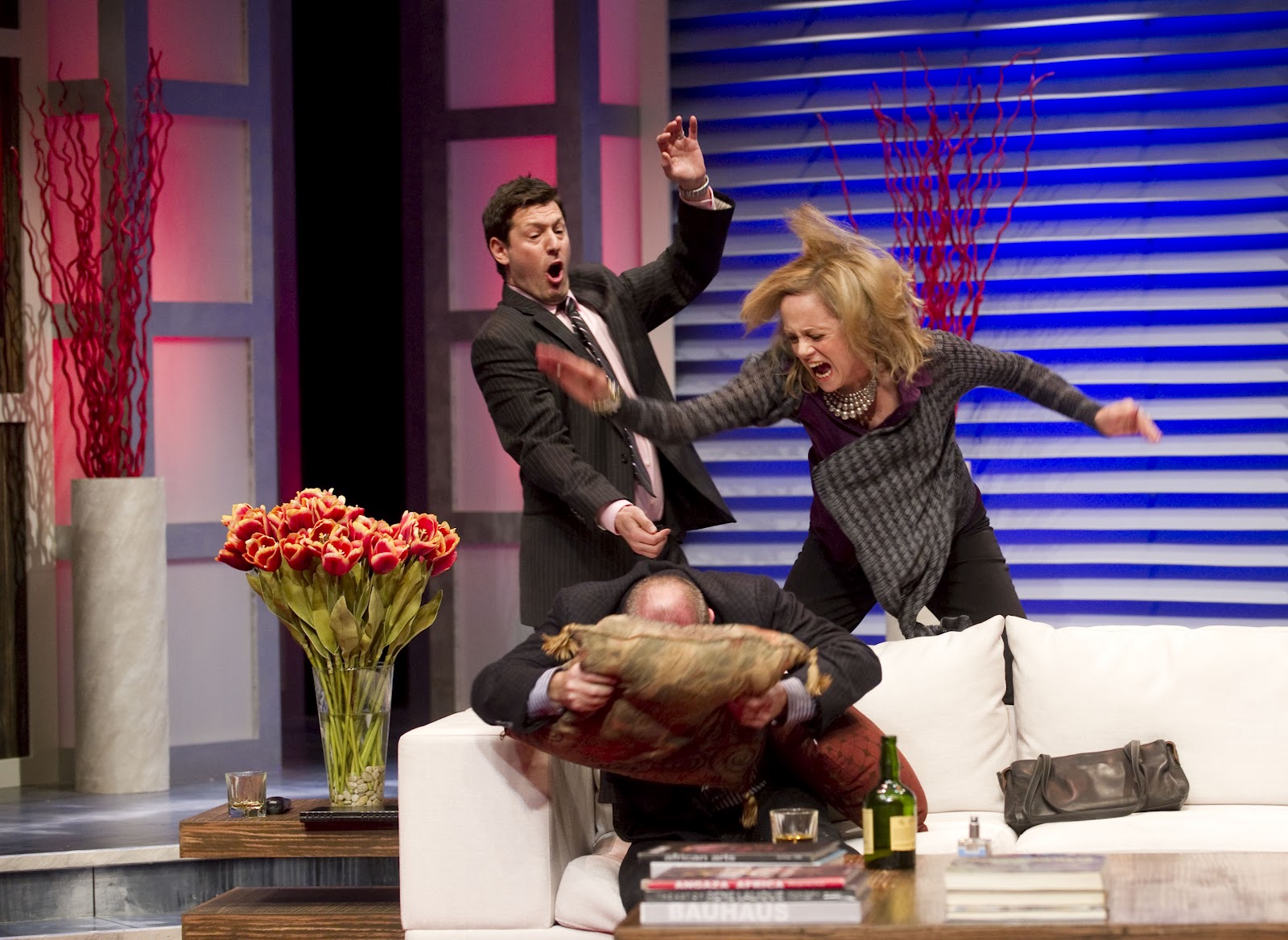
Veronica (Fiona Reid) gets ready to smack her husband Michael (Ric Reid) as Alan gets drawn into the fray in God of Carnage.
Yasmina Reza's God of Carnage, running at the Citadel Theatre until April 1, beyond being a giddy evisceration of our culture's ideals about love, marriage and family, is a relentlessly hilarious farce.
Reza's Tony-award-winning play, translated from French by Christopher Hampton, begins with Alan (Ari Cohen) and Annette (Irene Poole) sitting in Veronica (Fiona Reed) and Michael's (Ric Reid) living room discussing how to resolve a conflict their sons have had at school. Alan and Annette's boy has bashed a couple of teeth out of Michael and Veronica's son's mouth with a stick, and all the parents can agree that such violence is unacceptable and that the perpetrator, whom Alan is prepared to concede is "a savage," should be made to acknowledge his transgression and probably make some amends to his school mate.
As the couples debate the moral issues and the parenting philosophies that bear upon the incident they're trying to resolve, the civility of the opening discussion gradually descends into a series of insults, recriminations, and eventually even a little light violence, all the while revealing that seemingly decent people, regardless of their good intentions and social conditioning, can become, in one way or another, devotees of The God of Carnage.
As the meeting unfolds, Annette gets woozy and pukes her guts out all over her hosts' carpet and one of Veronica's prized possessions. Ric Reid's vigorous work with a dustbuster and a hairdryer cashes in on the comic currency of the vomit gag terrifically. Fiona Reid's obsessing over her vomit-saturated book seriously silly stuff.
The whole 90-minute play takes place on one set, but director James MacDonald has given the cast plenty room to milk Reza's dark wit and aggressive slapstick. Ric Reid and Poole's comic timing is totally pro, Fiona Reid's move toward derangement shows some accomplished comedic chops.
Fiona Reid is the idealist of the bunch, but once her threshold for patience and liberal tolerance is reached as Alan and Annette become less and less interested in conceding their son's faults, Reid becomes the God of Carnage's most passionate maenad, ready to dismember her husband as readily as her detestable adversaries in this demoralizing morality play.
Reza is utterly unsentimental about how couples can behave. Partners under stress can become incompatible strangers. (The divorce rate isn't as high as it is for nothing.) A common cause, like defending your own child against another tribe's impositions, has a tenuous hold when issues move from the domestic to the strictly personal. Throughout the play the characters find their allies on the other side of the conflict, which precipitates the slide toward chaos.
Reza's play has a dramatic arc that builds both the comic and the catastrophic dimensions of the action masterfully, and she's a mordantly funny writer, too. The climactic explosions of personal contempt (not to mention some propulsive gastro emissions thrown up) will shock some viewers, and Hampton's translation of the coarse language every character resorts to as debate deteriorates into derision and disgust is perfectly idiomatic. Great swearing can be at least as funny as an excellent display of hurling when done right.
The Citadel has mounted a wonderful play that should make you laugh till it hurts, and go away exhilarated and probably depressed by Reza's indictment of people's incapacity to mend fences that separate their common ground.
Bill Rankin